

To choose the right patio awning for your patio, select a model based on the size and location of your outdoor space, the dimensions of the area you want to shade, and the control system based on how often the awning will be used. A motor provides easier control for frequent use, while crank may be a good fit for a smaller awning that is used less often.
Start by determining how wide the awning can be, how far it needs to extend over the patio, and how much headroom there is when it is extended. This will make it easier to determine which design and control system is best suited for the space.
In this article, we’ll go over the dimensions that determine size, what distinguishes different types of patio awnings, when a motor or crank is the best fit, and what you need to consider regarding materials, accessories, and installation.
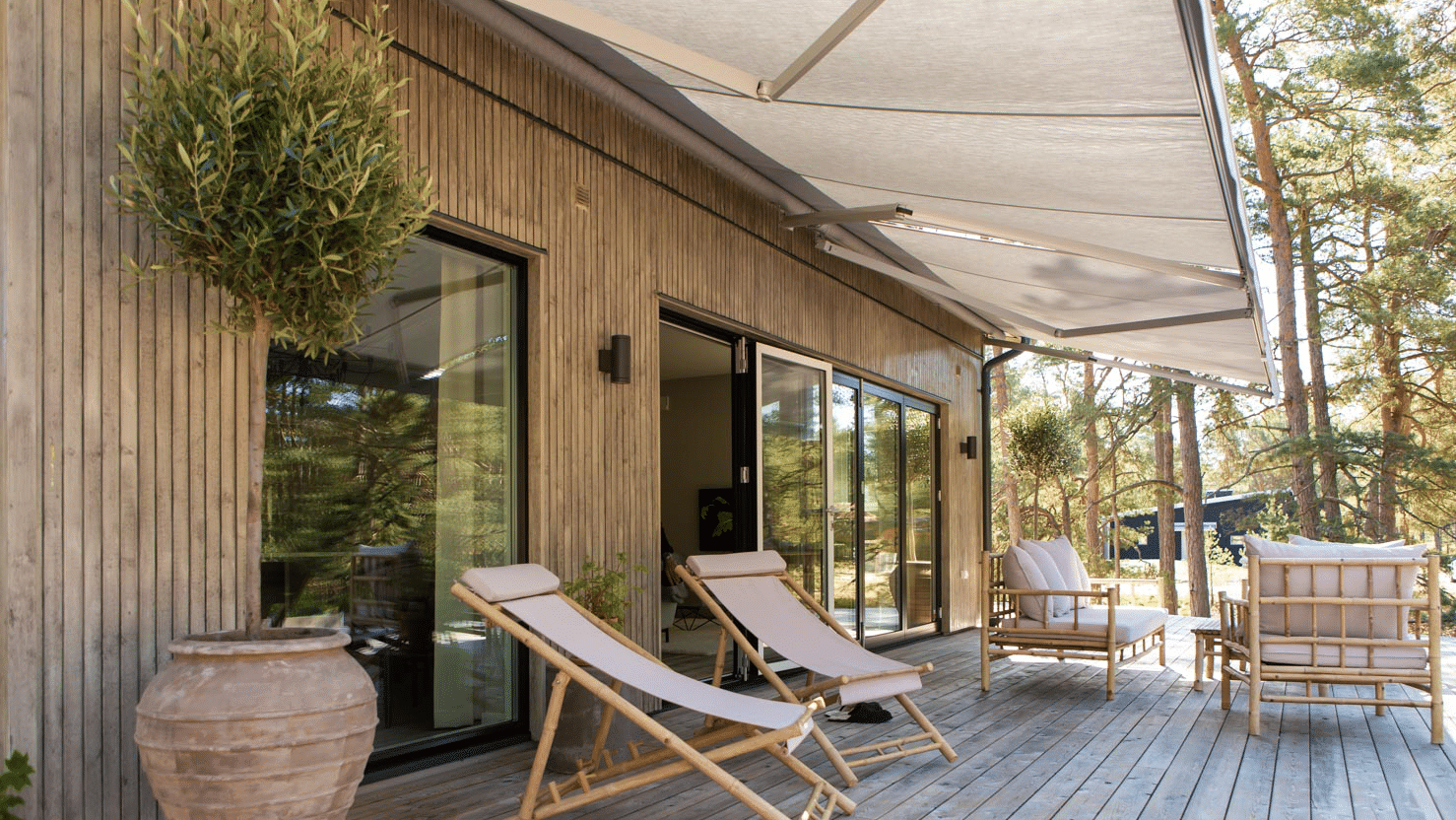
What measurements do you need to take before ordering a retractable patio awning?
Start by checking the width along the façade, how far the awning needs to extend over the patio, and how much clearance there is when it is extended. These measurements need to work together so that the awning fits the installation site and provides shade where you actually need it.
When comparing patio awnings, you also need to take into account any fixed obstacles and how the patio is used. Therefore, always measure the actual installation site before deciding on the awning’s dimensions.
- Width
- Measure the section of the façade where the awning will be installed and check the space around corners, downpipes, windows, and other fixed obstacles. Patio awnings can be custom-fitted up to 500 cm in width.
- Projection
- The projection is how far the awning extends from the façade when it is fully extended. Measure from the façade to the outermost part of the patio that you want to shade, and use the location of, for example, the dining area or seating area as a reference point.
- Clearance and slope
- Check both the mounting height at the façade and the height below the front edge of the awning when it is extended. The awning needs to be able to tilt downward without coming too close to doors, walkways, or other parts of the patio.
What size retractable patio awning suits a standard deck?
The size needs to be adjusted based on the depth of your patio and the area you want to shade. The measurements below are general guidelines to help you compare how much area different sizes can cover.
Consider the dimensions as guidelines rather than fixed standard measurements. The width can be adjusted to fit the façade, while the correct projection depends on how deep the patio is and where the shade needs to fall.
Small deck
Perfect for a small patio where you want to provide shade for, say, a small dining table or a seating area.
Standard-sized deck
Provides approximately 12 m² of coverage and is suitable for many decks with space for a dining set or a larger seating area.
Larger terrace
Provides more shade over a larger patio and is ideal when both the dining area and the lounge area need to be covered.
What is the difference between open awning, semi-cassette, and full cassette?
The main difference is how much of the fabric and the arms are protected when the patio awning is retracted. An open awning leaves the mechanism more visible, a semi-cassette primarily protects the fabric, and a full cassette encloses both the fabric and the arms.
| Property | Open awning | Semi-cassette | Full cassette |
|---|---|---|---|
| Design | Fabric and arms are more exposed | The fabric has a protective cover | The fabric and arms are enclosed in the cassette |
| Protection when retracted | Least protection | More protection for the fabric | The most comprehensive protection |
| Arms | Visible when the awning is retracted | Usually still visible | Hidden inside the cassette |
| Appearance when retracted | The structure is clearly visible | Partially covered structure | A more enclosed and streamlined profile |
| Price level | Usually lower | Usually between | Usually higher |
Should you choose a retractable patio awning with a motor or crank?
A motorised patio awning is best suited when the awning is used frequently or is larger and heavier to manoeuvre, while a crank is a simpler and non-electric alternative for a smaller awning that is used less often.
The difference is most noticeable in everyday life. A motorised patio awning can be opened and closed with the push of a button, while a manual patio awning requires you to crank the awning in and out yourself. How often the awning is used and whether there is electricity at the installation site are therefore important factors in making your choice.
Easier to use with frequent use
With the motor, the awning can be opened and closed using a remote control or another compatible control system. This is especially convenient on a wider patio awning or when the awning is adjusted several times throughout the day.
A simple manual solution
A patio awning with a crank requires no motor control and works without electricity. It’s a good fit for a small patio, a holiday home, or when the awning is only opened and closed occasionally.
What materials are important in a retractable patio awning?
The fabric, frame, and folding arms are the components that primarily affect the patio awning’s performance and how well it withstands outdoor use. The choice of materials is therefore about more than just colour and appearance.
A good patio awning combines a durable acrylic fabric with a sturdy aluminium frame and folding arms that help keep the fabric evenly tensioned when the awning is extended.
- Awning fabric
- Balustradedesign’s patio awnings have fabric made of 100% acrylic weighing at least 300 g/m². The fabric is Teflon-treated to repel water and dirt and has good colour fastness over long outdoor use. The fabric is water-repellent, but the awning is primarily a sunshade, not a roof for heavy rain.
- Frame
- The frame consists of extruded and powder-coated aluminium profiles. The powder coating gives the aluminium frame a durable surface suitable for outdoor use and requires little ongoing surface maintenance.
- Folding arms
- The folding arms extend from the façade and help keep the fabric taut. The design features enclosed wires that, together with the spring mechanism, contribute to a consistent fabric tension when the patio awning is extended.
Which retractable patio awning accessories are worth considering?
The right accessories depend on where the patio awning is located and what problem you want to solve. A semi-cassette provides the retracted fabric with more protection, while flexible adjustment allows you to adjust the angle according to the sun's position.
There are also optional accessories such as wind braces and front roller blinds. They can be useful in certain settings, but are not included in Balustradedesign’s product line.
Semi-cassette
A semi-cassette, or aluminium top cover, protects the awning fabric from rain and dirt from above when the awning is retracted. This is particularly relevant for an open patio awning, where the fabric would otherwise be more exposed.
Flexi-Adjust
Flexi-Adjust allows you to change the awning’s angle of inclination and adjust the shade as the sun moves through the sky throughout the day. This feature is available on certain patio awnings, so please check to see if it’s included with the model you choose.
Wind brace
Wind braces are a mechanical accessory that can provide additional support for an extended awning in areas exposed to strong winds. They do not eliminate the need to retract the awning in strong winds and are not included in Balustradedesign’s product line.
Front roller blind
A front drop blind is a vertical screen fabric at the front edge of the awning that can block low-angle sunlight and give extra privacy. Front roller blinds are not included in Balustradedesign’s product line.
What do you need to check before installing a retractable patio awning?
First, check which regulations or any permit requirements apply to the façade and the installation. Then, make sure that the installation site has a suitable load-bearing surface. If you are not responsible for the façade yourself, you also need to check what is permitted before ordering or installing awning.
Check these four points
-
Check the rules and any required permits
The applicable requirements may depend on the type of building, its location, and the regulations in effect where the awning is to be installed. Therefore, check what applies to the specific building and location before ordering or installing the awning.
-
Check what is permitted on the façade
If you are not responsible for the façade yourself, there may be requirements regarding for example, colour, size, placement, and fixing. Therefore, make sure that the planned awning and installation are permitted before work begins.
-
Check the substrate for the fixings
The awning brackets must be mounted on a surface that can support the load. Therefore, check the wall’s construction and follow the instructions in the installation instructions for the specific awning and the surface to which it will be attached.
-
Plan the electrical connection if you choose a motor
If the installation involves electrical work, it must be performed in accordance with the rules and qualification requirements that apply where the installation is taking place. Therefore, plan the electrical connection at the same time as you determine the awning’s location.
Check the regulations and any required permits before placing an order, then ensure that the awning can be securely anchored to the proper surface, and plan for any electrical connections before beginning installation.
Which retractable patio awning is the best fit for your deck?
Start by considering the dimensions, how far the awning needs to extend, and how you want to operate it. Customer service will be happy to help you review your options before you place your order.
What do you need to know before choosing a retractable patio awning?
Here are brief answers to common questions about size, projection, cassette types, weather, regulations and wall mounting.
What size retractable patio awning do I need for my deck?
The size depends on the width of the façade, the depth of the patio, and the area you want to shade. As a general guideline, 3 × 2.5 metres is suitable for a small patio, while 4 × 3 metres or larger may be suitable for a medium-sized or larger patio.
How far should a retractable patio awning project?
The projection should be adjusted based on how far out over the patio the shade needs to extend. Measure from the façade to the outermost part of the area you want to shade, and take into account where, for example, the dining table or seating area is located.
What is the difference between open awning, semi-cassette, and full cassette?
The difference lies in how much of the awning is protected when it is retracted. An open awning leaves the structure more exposed, a semi-cassette primarily protects the fabric, and a full cassette encloses both the fabric and the arms.
Can a retractable patio awning remain extended in rain or wind?
A patio awning is primarily a sunshade and should be retracted in strong winds, heavy rain, and snow. The awning fabric may be water-repellent, but the design is not intended to function as a permanent rain shelter.
Do you need to check the regulations or permits for a retractable patio awning?
Yes, that may be necessary. The applicable regulations or permit requirements may depend on the type of building, its location, and how the awning affects the façade. Therefore, check the requirements for the specific location before ordering or installing the awning.
What happens if you are not responsible for the façade yourself?
If you are not responsible for the façade yourself, there may be requirements regarding, for example, the awning’s placement, size, frame colour, fabric, and fixing. Therefore, make sure that the planned awning and installation are permitted before you place an order or begin the work.

