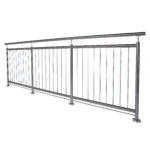
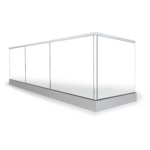
Price
The price is based on a 10-metre balustrade and our standard options for aluminium balustrade. The actual price per metre may be higher or lower depending on the options you choose and the size of the balustrade you purchase.
Production time
The time indicated is our estimated production time, i.e., when we will be ready to ship the goods. Depending on how the product is customised, this time may be longer, as indicated in the price quote.
You can always see the estimated production time and date for the order at checkout before placing your order.
NOTE: The times refer to weekdays, not business days.
Express Production
Express production is an optional service. The turnaround time for express production is fixed, but this service is not available for all products and designs. You only pay for the service if we meet the turnaround time requirement.
The service is ordered at checkout.
NOTE: The times refer to weekdays, not business days.




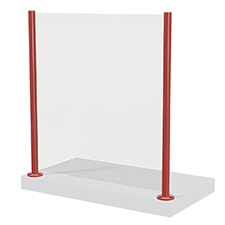
See how others have designed their staircase balustrades, glass balustrades for patios and frameless balustrades for balconies. Find inspiration among modern, classic and discreet solutions – each with a personal touch.
Browse our frequently asked questions and answers, or contact one of our specialists, who are happy to help.
A frameless glass balustrade has no visible posts between the glass panels, while a glass balustrade with posts supports the glass using posts and hardware. A frameless design offers a more unobstructed view and a cleaner, more minimalist look, while posts provide more opportunities to combine materials and details.
In a frameless balustrade, the glass is held in place by a sturdy base channel, which places higher demands on the mounting surface and requires thicker glass – which is why it’s more expensive. With posts, the posts themselves, their colour, and the top rails can become part of the design. A frameless balustrade is best when the view is the most important factor, while posts offer greater freedom in terms of materials and design.
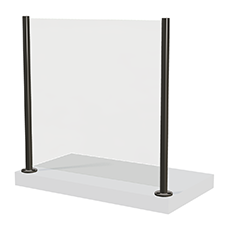
The most common options are clear glass, opal glass, and tinted glass, and for certain applications, ultra-clear and coloured glass are also available. The choice depends on how much of a view, light, and privacy you want, as well as the look you’re going for. Clear glass provides the best view and the most light, while ultra-clear glass has a less green tint for an extra-clear look.
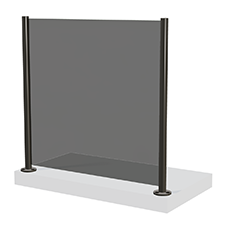
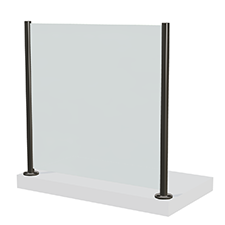
Opal glass lets daylight through but hides detail, and tinted glass, such as grey, gives a darker look and slightly more privacy. The same glass types are available for windbreaks. You can combine glass types in the same project, for example clear glass facing the view and opal glass facing the neighbours.
The suitable glass thickness depends on the panel size, balustrade system, fixings and loads. Common laminated glass thicknesses used in balustrades include 8.76 mm (two 4 mm panes) and 12.76 mm (two 6 mm panes). Thicker glass is not automatically better or safer.
The glass and fixings must be specified to work together. Consider the post spacing, glass height, type of clamps or profiles and whether the glass is laminated or toughened laminated. The finished glass panel must be slightly smaller than the opening between posts to allow for fittings and installation tolerances.
The easiest way to clean a glass balustrade is with lukewarm water, a mild detergent, and a soft microfiber cloth or window squeegee. Avoid strong or abrasive cleaners, which can damage the surface of the glass or the balustrade’s hardware. How often this is necessary depends on the location. Near the sea, roads, or areas with high pollen counts, the balustrade may need to be washed more often.
A nano-coating makes the glass more water-repellent, so dirt and limescale don’t stick as easily, but it doesn’t replace cleaning. Also wipe down the clamps and hardware – stainless steel ones with water and a mild detergent, painted ones with a soft cloth – and check at the same time that they’re securely fastened.
Glass balustrades use safety glass that is tailored to the balustrade’s design, glass dimensions, mounting, and load-bearing capacity. Common options include laminated safety glass and toughened laminated glass, and the entire system determines which type is needed. The glass is selected based on the entire balustrade system.
Laminated glass consists of two glass panes with an interlayer that holds the glass pieces together if the glass breaks, so that it does not shatter immediately. Toughened laminated glass is used when the system requires greater strength, such as for large glass panes or in exposed locations. If a pane of glass has cracked, it must be secured and replaced, since its properties have changed.
Your basket will be emptied if you switch to another country.
Sense is an aluminium glass balustrade that can be customised with a choice of colours and glass – so it fits your style and the space's conditions.
See immediately in the configurator how your choices affect the appearance.
Toughened glass is available for all glass types
White (RAL 9010)Sense is an aluminium balustrade in which the glass is fitted directly into the post profile instead of using glass clamps. The design gives clean lines with no protruding parts. The system is based on round aluminium posts and is delivered as a made-to-measure kit with posts, cut glass and rubber strips for securing the glass.
The system allows for wide glass sections, which reduces the number of posts and provides good visibility. The balustrade is designed for both outdoor and indoor environments.
A glass balustrade with round aluminium posts can be assembled without specialist tools, provided the installation conditions are suitable. First secure the posts to the supporting structure, then fit the glass panels into the post profiles in accordance with the instructions.
How installation works:
Below are examples from some of our installation videos. Once you've placed your order, you'll have access to videos tailored specifically to your balustrade and the choices you've made.
Sense is manufactured at our facility in Ängelholm. Through in-house design and production, we ensure that every balustrade is of high quality and meets the safety requirements for load-bearing construction products made of aluminium and glass. Each order is customised according to your preferences and comes with a declaration of performance.
The manufacturing process is certified in accordance with EN 1090-1 and complies with applicable Eurocodes for load-bearing capacity and performance. Production is continuously monitored by RISE (Research Institutes of Sweden), which is responsible for external verification of traceability, quality, and the manufacturing process.
In addition, we conduct our own tests to ensure that materials, fixing, and glass maintain the proper quality over time.
Here you'll find technical specifications, dimensions, assembly instructions, and performance declarations for Sense.
This information provides a clear picture of how the balustrade is constructed and helps you plan, compare, and install the right solution for your project.
Load-tested posts
The posts have been tested with top-mounted and side-mounted fixings on timber substrates and can withstand a load of 0.5 kN/m.
Round posts, Ø48 mm
The posts are round, with glass panels fitted into the post profile. The post diameter is 48 mm.
Surface coating: 20 µm
Our aluminium profiles are anodised. This is the same principle used on the mast of a sailboat, which is resistant to wind and weather.
Material thickness 2 mm
8.76 mm laminated glass
Two 4 mm glass sheets bonded with a plastic interlayer. If the glass breaks, the interlayer helps retain the fragments. Supplied with ground and polished edges.
8.76 mm toughened laminated glass
Same construction as our standard laminated glass, but with two toughened glass panels instead. We recommend this glass for environments where the balustrade may be exposed to repeated external stresses. Comes with ground and polished edges.
Glass options (colour)
When configuring your balustrade, choose clear glass or laminated glass with a grey-tinted or opal interlayer. The coloured or frosted film is positioned between the glass sheets.
Aluminium glass trim
A U-shaped aluminium profile (14×12 mm) is attached to the side of the glass with adhesive. Surface coating: 20 µ. The profile comes fully assembled; you then slot it into the post and secure it with screws.
Symmetrical Sections
When you enter your measurements in our configurator, you always specify the edge dimensions at the location where you want the balustrade installed. Our configurator then makes the necessary adjustments. For your balustrade, we then adjust the section dimensions so that each section on either side is the same length. In other words, we customise the balustrade to fit your measurements – not the other way around.
Choice of balustrade height
In the configurator, choose a height from 800 to 1,100 mm, measured from the floor to the top of the balustrade. Check the appropriate height for your installation against the relevant local requirements, particularly where there is a fall risk.
Made to the millimetre
When you provide your measurements, please be as precise as possible – down to the millimetre. We’ll craft your balustrade to the millimetre so that it fits perfectly in the spot where you want to install it.
Complete kits
Everything you need for installation is included in the delivery. Along with the posts and glass, we supply screws, drill bits, screwdriver bits and any special tools required. You will only need a drill/driver, an adjustable spanner, a folding ruler and a spirit level.
Assembly Videos and Instructions
The videos show various steps to help you with your assembly. Our assembly tips and videos are customised for each order. In other words, these are not general descriptions but are tailored specifically to your order.
Top mounting
The base is secured to the floor with 3 screws.
Screw for timber fixing
If you choose to fix into timber, screws are included for this purpose. The screw is made of hardened steel and, for outdoor use, is also surface-treated with Corrseal – Corrosion Class C4. The screw features a milled groove along the shank and one at the tip. This results in a very low screw-in torque in harder timber and minimises cracking.
Screw for concrete fixing
If you choose to fix into concrete, screws for this purpose are included. The screw is made of hardened steel and, for outdoor use, is also surface-treated with Corrseal – Corrosivity Class C4. Approved for use in cracked concrete, uncracked concrete, and hollow-core slabs. Also suitable for solid brick, hollow brick, solid Mexi brick, and natural stone. For fixing in materials other than timber or concrete, we recommend contacting your local builders’ merchant.
Aluminium Parts
Posts or other aluminium parts require minimal maintenance. If stains appear, a mild detergent, water, and a soft cloth are usually sufficient. Do not use products with abrasive properties, acids, or alkaline agents.
Glass
Clean the glass with a window and mirror cleaner and a soft cloth. For stubborn marks, methylated spirits can be used. Then clean again with window and mirror cleaner. Do not use abrasive cleaners on glass.
Our A+, A, B and C use classes provide guidance on where a particular balustrade configuration may be suitable. They draw on our product testing and take into account factors such as the chosen height, section width and components. These are our own product classifications, not UK building regulation categories. The installation must also meet the requirements that apply at its location.
Use class A+
Our A+ configuration is documented for a minimum horizontal line load of 1 kN/m. The suitability of a particular balustrade for a residential, commercial or public setting depends on the complete configuration and the requirements of the installation site. Where glass is included, the specified safety glazing should be assessed as part of the whole system.
Use class A
Our A configuration is documented for a minimum horizontal line load of 0.5 kN/m. Whether that configuration is suitable for a particular residential installation depends on the site and its applicable requirements. Where glass is included, the specified safety glazing forms part of the overall system.
Use class B
Our B configuration is documented for a minimum horizontal line load of 0.5 kN/m. Whether it suits a particular installation depends on the site, the difference in level and the applicable requirements. Where glass is included, safety glass is used to reduce the risk of injury on impact.
Use class C
Use class C is intended for ground-level settings. Where glass is included, safety glass is used to reduce the risk of injury on impact. A balustrade may also be classed as C if Balustradedesign, in consultation with you, makes a change that deviates from our standard. Class C then indicates that this specific configuration has not been tested.