

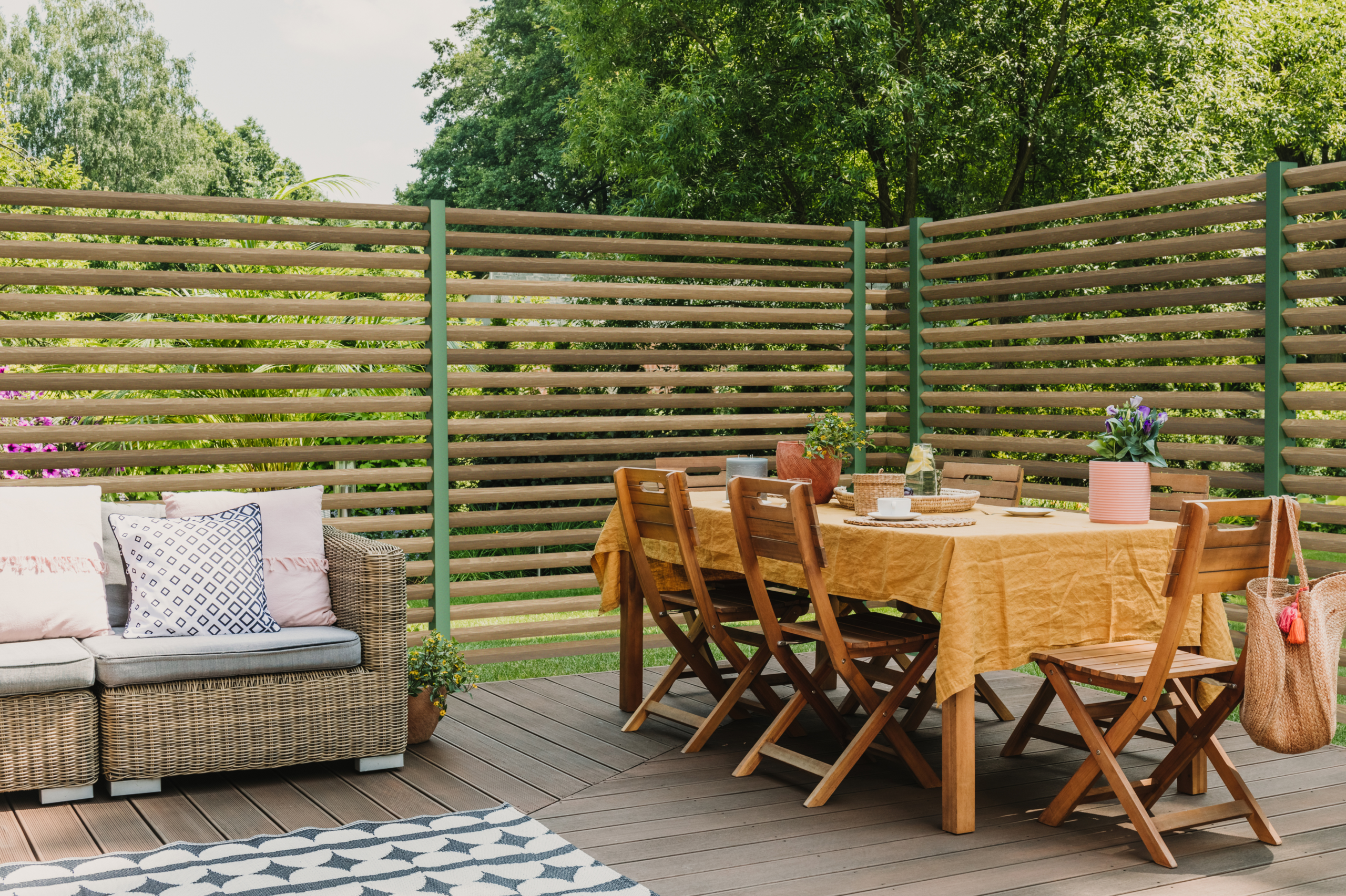
With Verto you build the slatted fence with maintenance-free aluminium posts as the frame and timber slats that you choose separately.
The integrated holes in the posts serve as a guide for slats and help keep the spacing and fence line even. This allows you to focus on placement, height, and the look you want to create with the wood.
The aluminium posts are maintenance-free. They do not need to be painted or oiled and are not susceptible to rot in the same way as timber posts, while the maintenance requirements for the timber slats depend on the type of timber and the finish you choose.
Why is the frame important when building a slatted fence?
The posts hold the slats in place and decide whether that the fence line remains straight over time. That’s why the frame needs to withstand moisture, weather, and seasonal changes without shifting so much that the overall appearance is affected.
Timber and aluminium react differently to these stresses. It is primarily this difference that determines how much ongoing maintenance the frame requires.
May change as the timber absorbs moisture
Timber is a living material that is affected by moisture and dryness. Over time, posts may warp, crack, or become misaligned, which becomes particularly noticeable when several posts are arranged to form a long, straight fence line.
Requires less routine maintenance
Aluminium does not absorb moisture in the same way as timber and is therefore not susceptible to rot. The posts also do not need to be oiled or repainted in the same way as a timber frame.
What post spacing should you use for a slatted fence?
With the aluminium posts in the system, the recommended centre-to-centre distance between posts is 1,400–1,650 millimetres. The most suitable distance depends, among other things, on the dimensions of the slats and how stable you want fence to be.
| What applies | Measurement or option |
|---|---|
| Recommended post spacing | 1,400–1,650 mm centre-to-centre |
| What factors affect the distance between posts? | Slat dimensions and desired stability |
| Post dimensions | 50 × 70 mm and 50 × 50 mm |
| Number of heights | 14 |
| Slats | Selected and purchased separately |
Measure the entire fence line and decide where it will start, end and change direction, if applicable. You can then position the posts evenly within the recommended centre-to-centre spacing.
What about horizontal slats and child safety?
If the slatted fence is installed at the edge of a drop-off and is intended to serve as fall protection, its design must take into account the risk of climbing and the size of the openings. This is particularly important in areas where young children are likely to be present.
Three things to check
- Climbing
-
Prevent climbing
Design the guarding so that horizontal parts and other details do not create unnecessary climbing opportunities where children may be present.
- Openings
-
Check the size of the openings
Openings must be designed with child safety in mind and in accordance with the requirements applicable to the location where the structure will be used.
- Location
-
Evaluate the overall design of the protection
Take into account the location of openings, slats, and other parts that can be grasped in relation to the floor, the edge of the drop, and surrounding structures.
What materials are best for building a slatted fence?
A slatted fence can combine different materials for the frame and slats. With aluminium posts, you get a frame that requires little ongoing maintenance, while the timber can be chosen separately to determine the fence’s colour, texture, and appearance.
The frame provides stability; the slats create the look
Aluminium reduces the need for maintenance
Aluminium does not absorb moisture in the same way as timber and is not susceptible to rot. The posts therefore do not need to be oiled or repainted in the same way as a timber frame.
The surface may be natural anodised aluminium or painted, depending on the finish selected.
The type of timber largely determines the character of the fence
The timber slats are sold separately, allowing you to choose the timber type and dimensions. Narrower or wider sections, different spacing and surface treatments can create very different appearances even when the frame is the same.
The maintenance requirements for timber slats depend on the type of timber and the finish you choose.
If you want to keep maintenance to a minimum, there is a difference between a low-maintenance frame and a completely maintenance-free fence. Aluminium posts require little maintenance, while timber still needs to be evaluated based on the specific material you choose.
What rules might apply to a slatted fence?
The rules and any permit requirements that apply to a fence depend, among other things, on the structure’s height, density, function, and location. An open slatted fence may be assessed differently than a tall, dense structure that clearly encloses an area.
More transparent
Wider spacing between the slats creates a more open structure that primarily serves as a boundary while still allowing both light and a clear view to pass through.
More screening
When the slats are placed closer together, the structure provides more screening. Different requirements may apply depending on its height, location and intended use.
Height, density, and location can affect the requirements
There is no single measurement that determines which requirements apply. Evaluate the entire structure and pay particular attention to the height, tightness, placement, and intended function of slatted fence.
Height and density
A tall or dense structure may be subject to different requirements than a low, open fence. The purpose of the structure may also influence the assessment.
Location and surroundings
The requirements may be affected by the location of the slatted fence – for example, near a boundary, a building, or a drop-off – and whether it is installed as a freestanding structure or attached to an existing structure.
Regulations and any permit requirements may vary depending on where the structure will be located. Therefore, always check with your local authority or the relevant body for the most up-to-date information before you build or place an order.
Hur bygger du ett ribbstaket?
Start by planning the length, height, and placement of the posts. Once the frame is stable and plumb, slats can be put in place and secured. With Verto, the pre-assembled top rail sets at posts help keep the timber level throughout fence.
Check these points when building your slatted fence
-
Measure the entire length of the fence
Determine where the slatted fence should start and end, and where it might need to change direction. This will make it easier to plan the placement of the posts before installation begins.
-
Determine the height and intended use
Choose the height according to how the space will be used, how much privacy or wind shelter you want and whether the fence also needs to prevent falls.
-
Space the posts along the run
The recommended centre-to-centre spacing is 1,400–1,650 millimetres. The most suitable spacing depends, among other things, on the dimensions of the slats and the level of stability you want to achieve.
-
Check the surface and make sure the posts are plumb
The subfloor must be strong enough to support the structure. When installing posts, use a level to ensure they are plumb before placing slats in position.
-
Fit the slats into the pre-set positions
Insert the timber slats into the integrated slat positions in the posts. These act as guides to keep the slats evenly spaced along the fence.
-
Fix the slats from the back of the post
Once the timber is positioned correctly, secure slats with a screw from the back of the post. Check regularly to ensure that the gaps and lines are even along the entire structure.
-
Do a final check
View the fence from several angles and check that the posts are upright, the slats are secure and the fence line is even along its entire length.
A straight frame is especially important in a slatted fence because even small deviations become apparent when many horizontal lines follow one another over a long distance.
Would you like to see what your fence could look like?
With Verto you can build a slatted fence with aluminium posts as the frame and choose the timber separately. In the configurator you can adapt the solution and see how the fence suits your patio or garden.
Frequently Asked Questions about slatted fences
Here are brief answers to common questions about posts, slats, post spacing, and maintenance when you're planning or building a slatted fence.
What is the advantage of aluminium posts for a slatted fence?
Aluminium posts do not absorb moisture in the same way as timber and are not susceptible to rot. They also do not need to be oiled or repainted like a timber frame, which reduces the need for ongoing maintenance.
What is the ideal post spacing for a slatted fence?
For the Verto, a centre-to-centre spacing of 1,400–1,650 millimetres is recommended between the posts. The most suitable spacing depends, among other things, on the dimensions of the slats and the level of stability you wish to achieve.
Are timber slats included when you buy Verto posts?
No. The Verto consists of the fence posts, while the timber is purchased separately. This allows you to choose the type of timber, dimensions, and finish yourself, depending on the look you want to create.
How tall should a slatted fence be?
The height depends on the fence’s function and location. A slatted fence intended to provide privacy or windbreak may need to be taller than a simple property boundary fence, while structures near a drop-off must also be evaluated based on fall protection requirements.
How do you install posts for a slatted fence?
Start by measuring and marking the locations of the posts. Then secure the posts to a sufficiently sturdy surface and use a level to ensure they are plumb before installing slats.
Can you build a slatted fence on a timber deck?
Yes, slatted fences can be used on decks and timber decking. The important thing is that the posts are anchored to a sufficiently load-bearing part of the structure so that the fence has the necessary stability.
How much maintenance do aluminium posts require?
Aluminium posts require little ongoing maintenance and do not need to be oiled or repainted in the same way as timber posts. The timber slats, on the other hand, are a separate material choice, and their maintenance depends on the type of timber and the finish.

