

Replacing an old balustrade on the deck or staircase is often a relatively straightforward project. However, what determines how easy the replacement will be isn’t just which new balustrade you choose, but what’s left behind after the old one is removed.
Above all, the existing mounting points play a major role. If the new balustrade can use the same post locations and holes, you’ll avoid both having to drill new holes and making unnecessary repairs to the substrate.
That’s why a good balustrade replacement project starts before you tear anything down. Take photos, measure the post spacing and hole pattern, and check the substrate around fixings. In this guide, we’ll walk you through how to do it, what to check during disassembly, and how to prepare the site for the new balustrade.
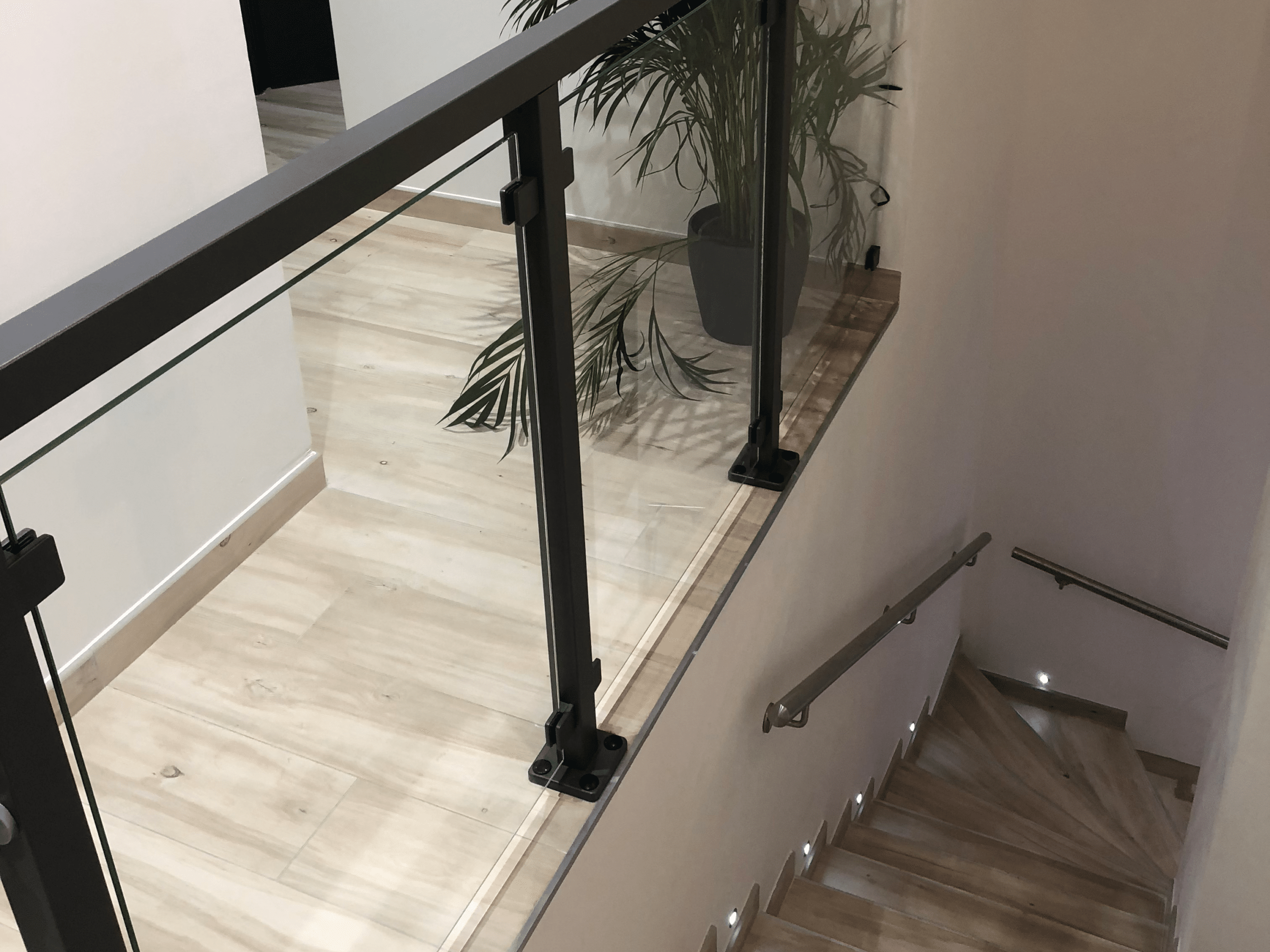
What should you measure before removing the old balustrade?
Measure each balustrade section, the distance between posts, the distance to the corners and ends, and the hole pattern in each base plate. Whether you’re replacing the balustrade on a deck or a staircase, you should document the measurements while the old balustrade is still in place.
Four measurements to take before removing the balustrade
-
Have you taken photos of every balustrade section?
Take a photo from corner to corner before removing any parts. It helps to write the measurements directly on the photo so that the placement can still be determined after disassembly.
-
Have you measured the distance between each post?
Measure each gap separately instead of assuming that all post spacings are the same. You can then compare those measurements with the post placement in the new balustrade.
-
Have you measured from the outermost post to the corner and the end?
Do this at both ends of the balustrade section and where the balustrade changes direction. This will allow you to restore the correct starting point and section divisions.
-
Have you documented the hole pattern in the base plate?
Measure the distance between the holes and take a photo of the base plate from above before removing it. Also note how the foot is oriented relative to the direction of the balustrade.
Can the old mounting points be reused?
In some cases, yes. If the new balustrade’s posts can be installed where the old ones were, it may be possible to use the existing holes and post locations. However, the location alone is not enough – the substrate must be intact, and the mounting solution needs to be compatible with the new balustrade.
It may be possible to use the old holes
Compare the measured post positions and hole pattern with the new balustrade. If the placement is correct, you’ll then need to check that the material around the fixing is intact and that the new fixing is suitable for the surface.
Plan for new mounting points
If posts need to be placed in other locations, the new balustrade should be designed based on its own post locations. The old holes should not dictate the placement if doing so results in a poorer or unsuitable fixing.
How do you remove an old metal balustrade without damaging the substrate beneath it?
Start by locating and exposing the fixings before attempting to remove the balustrade. Screws and bolts may be hidden under covers, caps, paint, or corrosion, and if a fixing is stuck, you should assess it before applying more force.
Three checks before loosening a fixing
-
Have you figured out how the balustrade is attached?
Start at the base of the post and look for cover caps, plastic plugs, or a loose cover over the base plate. A base cover can often be lifted or twisted aside to reveal the screws underneath.
-
Is the screw head completely exposed?
On older balustrades, screw heads may be painted over or covered with dirt and corrosion. First, expose the fixing so that the tool gets a firm grip and the risk of damaging both the screw and the surface is reduced.
-
Can the fixing be removed without damaging the substrate?
Avoid using force to remove a stuck bolt. For example, if a fixing is firmly embedded in concrete, the method and tools must be adapted to both the fixing and the substrate. In some cases, a stuck bolt can be cut flush with the surface instead of being pulled out.
What should you check in the substrate after dismantling?
Check for rot or soft wood in timber, cracks and spalling in concrete, and loose or damaged material in masonry and brickwork. Any damage around the old fixings must be repaired before new fixings are planned.
| Supporting structure | Here's what you should check |
|---|---|
| Timber | Discolouration, soft timber, or rot around the old fixings. Pay special attention to the area around the holes, as moisture penetration often becomes apparent there. |
| Concrete slab | Cracks, flaking, and frost damage around the holes. Also check that the material closest to the old fixing is still intact. |
| Masonry edge | Check whether the mortar is firm or if it has weathered or come loose around the former fixing. |
| Brick | Check whether the old fixing is embedded in the brick or in the mortar, and whether the material around the hole is still intact and stable. |
What changes when you switch from traditional wrought iron to aluminium?
You’re switching from a material that requires effective corrosion protection to one that doesn’t rust in the same way. The difference is therefore noticeable both in terms of maintenance and the material’s properties, even though the visual appearance can remain relatively similar.
Older steel or wrought iron
Steel requires effective corrosion protection. When paint or a surface treatment is damaged, rust can begin to form on the exposed steel.
Powder-coated aluminium
Aluminium does not rust in the same way as steel. The surface still needs to be cleaned and maintained, but the material does not require the same type of rust protection.
What should you be sure to check while the balustrade is being replaced anyway?
Above all, check the height, whether the balustrade can be climbed, the gap at the bottom, and the placement of the balustrade. A new balustrade does not have to replicate the old design if it had flaws that can be improved upon when the balustrade is replaced anyway.
Four things to check before planning your new balustrade
-
Was the old balustrade too low?
Check whether the height is still appropriate for the location and the risk of falling. When the balustrade is replaced, it is possible to correct a balustrade that was previously too low.
-
Was it possible to climb the lower part?
Horizontal sections and other design features can make a balustrade easier to climb. This is especially important to keep in mind in areas where young children may be present.
-
Was the opening at the floor unnecessarily large?
Check the distance between the bottom edge of the balustrade and the floor or stairs. When planning a new balustrade, that part of fall protection must also be safe.
-
Was the balustrade set back far enough to create a ledge?
If the balustrade is far from the edge, it may be possible to stand or step on the area outside it. Therefore, check the placement as part of the new solution, not just the positions of the old holes.
What should you check before ordering the new balustrade?
Make sure you have documented the old balustrade, measured the post positions and hole layout, assessed the substrate, and determined which fixings can actually be used. Place your order only after you have the actual measurements and know what the site looks like after dismantling.
Seven Things to Consider Before Choosing Your New Balustrade
-
Have you taken photos of every balustrade section?
The photos show how posts, the corners, and fixings were positioned before dismantling. Please take photos from multiple angles so that the placement can be determined even after the old balustrade is removed.
-
Have you measured the post positions and the hole pattern?
Measure the distance between each post, from the outermost post to the corners and ends, as well as the location of the holes in the base plates.
-
Is the substrate intact around the old fixings?
Check for discolouration, soft spots, or rot in wood; cracks and spalling in concrete; and damage to mortar, brick, or joints. Any damage must be repaired before planning new fixings.
-
Do you know which old mounting points can be reused?
Compare the measured post positions and hole pattern with the new balustrade. Even if the placement is correct, the substrate and fixing arrangement must be suitable for the new structure.
-
Are you ordering based on the actual measurements?
Base your calculations on the measurements you took on site rather than on an older drawing or the assumption that the deck, staircase, and post locations are perfectly regular.
-
Can seized fixings be removed without damaging the surface?
Avoid using excessive force to remove bolts if there is a risk of damaging the surface. If a fixing cannot be removed, the method and tools must be adapted to both the fixing and the substrate.
-
Have any holes that are not to be used been repaired and sealed?
Any remaining holes should not simply be hidden under the new balustrade. Repair and seal them using materials and methods appropriate for the substrate.
Which balustrade is the right choice when you're replacing the old one?
Once you’ve checked the measurements, fixings, and the surface conditions, you can choose a new balustrade based on the site’s conditions, the look you want, and how much maintenance you’re willing to do.
What do you need to know when replacing an old balustrade?
The most important thing is to document the old fixings before dismantling it, check the substrate once the balustrade is removed, and plan the new balustrade based on the actual measurements and conditions of the site. Here are brief answers to common questions about the replacement itself.
Can I use the old holes when I replace the balustrade?
In some cases. If the new balustrade’s posts and hole pattern match the existing mounting points, it may be possible to reuse them. Also check that the surface around the holes is intact and that the mounting solution is suitable for the new balustrade.
How do I remove an old metal balustrade?
Start by locating fixings. Screws and bolts may be hidden under covers, caps, paint, or dirt. Expose the fixing before attempting to loosen it, and avoid using force if there is a risk of damaging the surface.
What should I do with any leftover holes?
Holes that will no longer be used should be repaired and sealed rather than simply hidden beneath the new balustrade. Use a method and material appropriate for the substrate so that no open holes remain where moisture can penetrate.
What should I check on the substrate once the old balustrade is removed?
For timber, check for discolouration, soft spots, and rot. For concrete, look for cracks, spalling, and frost damage. For masonry and brick, make sure the material around the old fixing is still intact and secure.
Can I replace an old wrought iron railing with an aluminium one?
Yes. An older steel or wrought iron railing can be replaced with an aluminium balustrade if the new design and fixings are suitable for the location. Aluminium does not develop iron rust like steel, and dark, slim profiles can help preserve a traditional appearance.
Do the safety requirements need to be reviewed when the balustrade is replaced?
Yes. When a balustrade is replaced, the new design should be evaluated based on the requirements applicable to the location, the building’s use, and the risk of falling. Regulations may vary between countries and projects, so do not automatically assume that the old design can be replicated unchanged.
How long does it take to replace an old balustrade?
It depends on the size of the balustrade, fixing, and the condition of the surface. Disassembly may take longer than expected if old screws and bolts are hidden, painted over, or corroded, so don’t plan the job based solely on the time it takes to install the new balustrade.

