
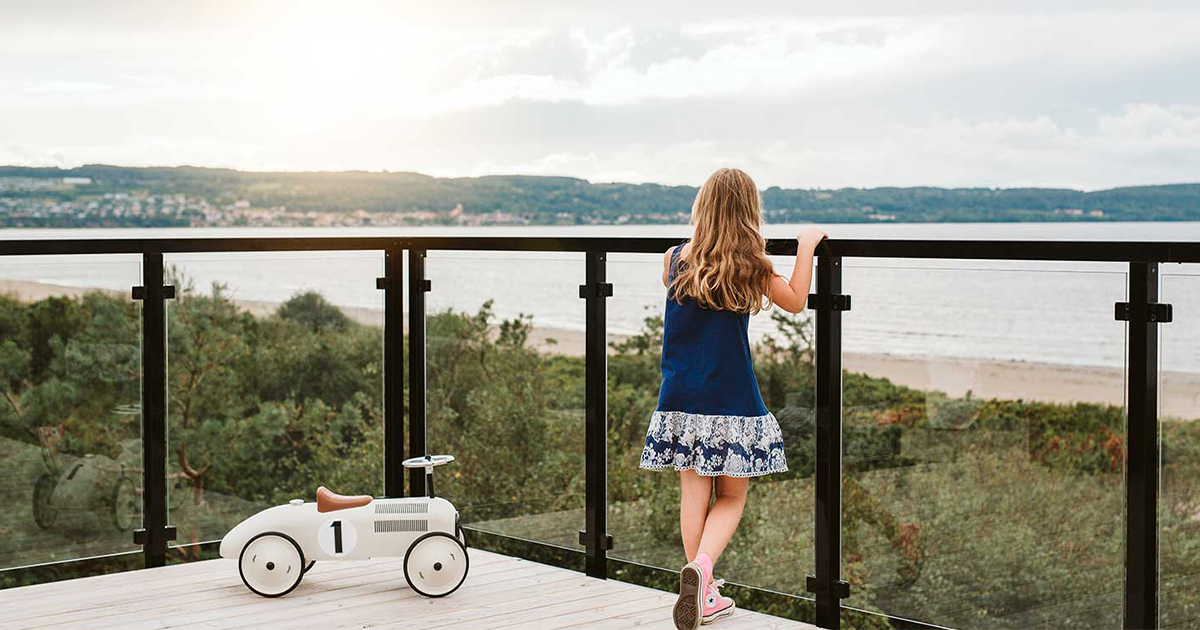
A child-safe balustrade is designed to reduce the risk of falls, climbing, and children getting stuck in openings. Therefore, in areas where young children may be present, you need to pay special attention to openings, the bottom edge, features that can be climbed on, and the height of the balustrade.
The design of the balustrade also depends on the location and the requirements that apply where the balustrade is to be installed. On decks, balconies, stairs, and lofts, you need to take into account the drop height, openings, and other features in the surrounding area that a child could use to climb.
In this guide we go through the rules and key dimensions for child-safe balustrades, how to reduce the risk of climbing and what is especially important to check on a deck, on stairs and in a loft. Exact requirements can vary depending on the location, so always check the current guidance before you build or order.
What makes a balustrade child-safe?
A child-safe balustrade is designed to reduce the risk of children falling through, getting stuck, or using the balustrade to climb. Therefore, small openings, a design that is difficult to climb, and the correct height based on the fall risk at that location are the three most important factors.
Small openings
Openings must be limited so that younger children cannot squeeze through the balustrade or risk getting stuck.
Hard to climb
The balustrade should not have horizontal parts, wire or other details that can act as steps where young children may be present.
The right height for the location
The height of the balustrade must suit the drop height, how the area is used and the rest of the design of the guarding.
What rules and dimensions apply to a child-safe balustrade?
The requirements for a child-safe balustrade may vary depending on where the balustrade is to be installed. The size of the openings, the bottom edge of the balustrade, the possibility of climbing, and the risk of falling at that location are some of the most important factors to check.
In areas where young children are present, the balustrade must be designed so that children cannot easily squeeze through openings, get stuck, or use parts of the structure as steps. The total height of the balustrade must also meet the requirements for the specific location and be adapted to the risk of falling.
Exact dimensional limits and requirements may vary. Therefore, always check the current guidelines from your local authority or the relevant body before you build or place an order.
| Checkpoint | What you need to check | Where does it matter most? |
|---|---|---|
| Openings in the balustrade | Check the maximum opening sizes allowed where the balustrade is to be installed. Openings must be small enough to reduce the risk of young children squeezing through or getting stuck. | Deck balustrades, balcony balustrades and staircase balustrades. |
| Gap beneath the balustrade | Check the distance between the bottom of the balustrade and the floor, decking, or other adjacent surface. Even a small gap can pose a risk to young children. | Balconies, decks, and other balustrades with an opening at the bottom. |
| Openings by the stairs | I trappor behöver även avstånden mellan räcket och trappsteg, trapplan eller golv kontrolleras mot de krav som gäller på den aktuella platsen. | Stairs, landings, and connections to the floor. |
| Climbing risk | Avoid horizontal parts and other details that could serve as natural steps or handholds for a child. | Balustrades with slats, struts, wire or other horizontal members. |
| The area around the balustrade | Furniture, flower boxes, and other objects near the balustrade can make it easier to climb. Therefore, also assess the area around the structure itself. | Decks, balconies, lofts, and other areas where children spend time. |
| Height of the balustrade | Check the minimum height required for the location where the balustrade is to be installed, and at the same time assess the drop height, usage, and the consequences of a fall. | Decks, balconies, stairs, lofts, and other changes in level. |
Which balustrades are best suited for families with children?
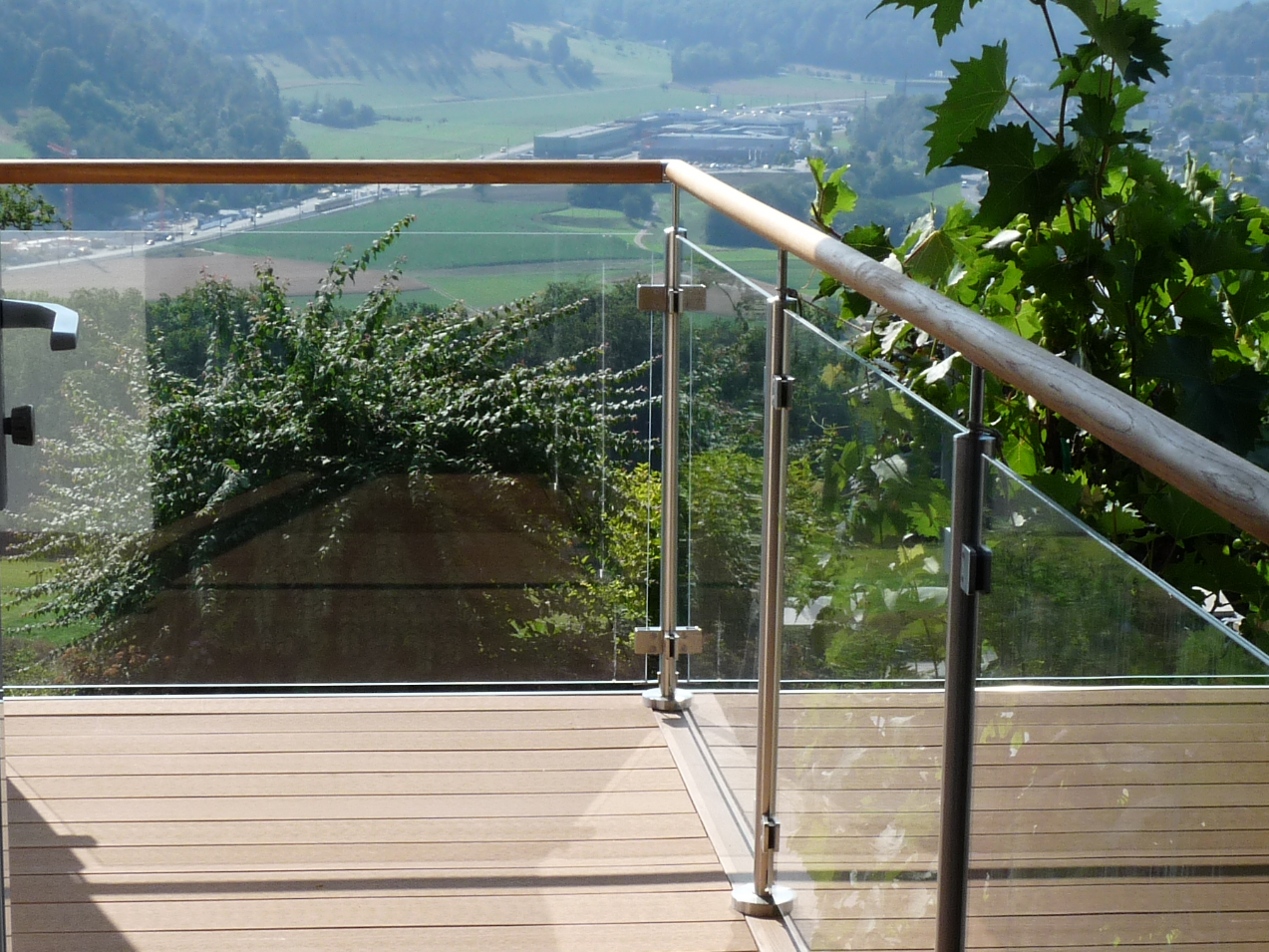
Balustrades with closely spaced or vertical bars and few features that can be climbed are often best suited for areas where younger children are present. A glass balustrade can, for example, provide a continuous protective surface, while vertical balusters can work well when the openings are kept small enough. Regardless of the material, it is the overall design of the balustrade that determines how well it functions from a child safety perspective.
Dense, stable, and difficult to climb
The material is only part of the decision. Also check the openings, the bottom edge, horizontal details, and anything around the balustrade that could be used as a step.
The same material can therefore perform differently depending on how the balustrade is constructed and where it will be installed.
- Glass balustrade
- Glass infill can create a continuous surface without any open gaps in the glass panel itself. At the same time, check the bottom edge, corners, fixings, and other parts of the balustrade.
- Aluminium balustrade
- Aluminium can be combined with, for example, glass or vertical elements. Child safety is therefore primarily determined by the balustrade’s design and openings, not by the aluminium itself.
- Stainless Steel Balustrades
- Stainless steel can be used in balustrades with glass or vertical members. Avoid designs with horizontal details that can act as steps where young children are present.
- Wrought iron railing
- Wrought iron can be suitable for both older and more traditional settings. Choose vertical elements with small openings and avoid decorations or horizontal details that make the balustrade easier to climb.
Can a child-safe balustrade preserve the view?
Yes. A balustrade designed with children’s safety in mind doesn’t have to feel heavy or block the view. A solution using glass can provide a continuous protective surface while preserving light and visibility.
This can be particularly valuable on decks, balconies, and lofts where the view is an important part of the space. Instead of creating safety with dense, visually heavy structures, the balustrade can be designed so that the protection is clear without making the room or the outdoor environment feel more confined.
At the same time, the design of the entire balustrade must be evaluated. Therefore, also check for openings at the bottom and in the corners, fixings, and other parts that could affect how the balustrade functions in areas where young children are present.
How does child safety differ between a deck, a staircase, and a loft?
On a deck or balcony, the focus is mainly on fall risk, openings and climbing, while a staircase also needs to be safe along the steps and landings. In a loft, the change in level and the risk of play near the balustrade are particularly important to consider.
Therefore, the balustrade needs to be adapted to how that specific space is used. The requirements regarding openings and climbing apply to the balustrade’s design, while other measures around a deck or staircase can be practical additions to everyday life.
Reduce the risk of falling and climbing
Above all, the balustrade here needs to be the right height to account for the risk of falling at this location, have small openings, and be designed in a way that does not provide the child with natural footholds to climb on.
Glass or vertical elements can work well when you want to maintain both light and a view.
Check all the way down the stairs
On a staircase, the openings must be checked both between the balustrade sections and at the bottom edge where it meets the steps, the floor, and the landing. At the same time, the balustrade should be difficult to use as a ladder.
When a child is small, a safety gate at the top or bottom of the stairs can be a practical addition to the balustrade itself.
Be especially careful when there are significant differences in elevation
In a loft, the balustrade is often located near an area where children play, sit, or move around a lot. In such cases, it is particularly important to assess the drop height, openings, and the possibility of climbing.
Choose a sturdy solution without any parts that could be used as steps, and make sure the guard is effective along the entire open edge.
What features make a balustrade easier for children to climb on?
Horizontal slats, struts, wire and other parts that act as footholds can make a balustrade easier to climb. Furniture, pots and boxes near the balustrade can also increase the risk of climbing, even if the balustrade itself is correctly designed.
In areas where younger children are present, it is therefore better to have a structure that has few horizontal handholds, small openings, and a protective surface that is as continuous as possible.
- Horizontal slats, struts or wire that can be used as steps.
- Openings or details that provide the child with handholds or footholds for hands and feet.
- Furniture, flower boxes, pots, or other objects placed near the balustrade.
- Glass or other continuous surfaces without horizontal climbing rungs.
- Vertical sections with small, evenly spaced openings.
- A solution in which the bottom edge, corners, and joints are carefully designed in conjunction with the rest of the balustrade.
What should you check before ordering a child-safe balustrade?
Check the site's drop height, the openings in the balustrade, and anything else that might make the structure easier to climb on. Also consider how the area around the balustrade will be used, so that the solution will still work even when the child gets bigger and more active.
Check these five points
-
Measure height and elevation difference
Start from where the balustrade will be fitted and how large the drop is. On a staircase, the dimensions must be assessed in relation to the steps, landing and floor.
-
Check all openings
Check the spacing between vertical components, the bottom edge, corners, and connections. Small openings in the wrong places can be just as important to detect as larger gaps in the balustrade itself.
-
Avoid features that can be climbed on
Pay special attention to horizontal slats, struts, wire and other parts that could serve as steps where young children are present.
-
Plan the area around the balustrade
Think about where to place furniture, flower boxes, and other objects. Items placed near the balustrade can make it easier for a child to climb.
-
Think beyond the early years of childhood
A child's reach, strength, and way of interacting with their surroundings change rapidly. Therefore, choose a solution that will still work as the child grows and becomes more active.
Don't base your decision solely on the balustrade's material or appearance. Check the dimensions, openings, climbing risk, and the area around the balustrade before you place your order.
Which balustrade is best suited for areas where children are present?
Consider the site's fall hazard, openings, and climbing risks. Our customer service team can help you compare options and check the dimensions before you order.
What do you need to know about child-safe balustrades?
The most common questions concern openings, climbing risk, glass balustrades, wire balustrades and what is especially important on stairs and lofts. Here are short answers to some practical questions.
How large can the openings in a child-safe balustrade be?
Requirements for the size of openings may vary depending on the location and type of balustrade. In areas where young children are present, the openings must be small enough to reduce the risk of children squeezing through or getting stuck. Also check the bottom edge, the landing, and the connections to the steps.
Why does the balustrade need to be assessed specifically in areas where young children are present?
Younger children can more easily climb, crawl through openings, or get stuck in parts of a balustrade. Therefore, openings, the bottom edge, climbable features, and the area around the balustrade must be assessed with particular care in areas where children may be present.
Is a glass balustrade a good choice for families with children?
A glass balustrade can be a good choice because the glass provides a continuous protective surface without any horizontal elements within the glass panel itself. However, the entire design of the balustrade – including the bottom edge, openings, and fixings – must still be evaluated.
Is a wire balustrade child-safe?
Wire balustrades are not always the first choice in areas where younger children frequently play, since horizontal wires can make the structure easier to climb. Therefore, assess both the gaps and the risk of climbing before choosing a solution.
Does a balustrade need to be taller if children are around?
The height of the balustrade should be determined based on the use of the area, the drop height and the design of the safety barrier. In areas where young children are present, it is also particularly important to check for openings and the risk of climbing.
What should I keep in mind when it comes to stairs or a loft?
On stairs and in lofts, the balustrade must provide protection along the entire open edge, have openings that are small enough, and be difficult to climb on. On stairs, a child safety gate can also be a practical addition when the child is young.
