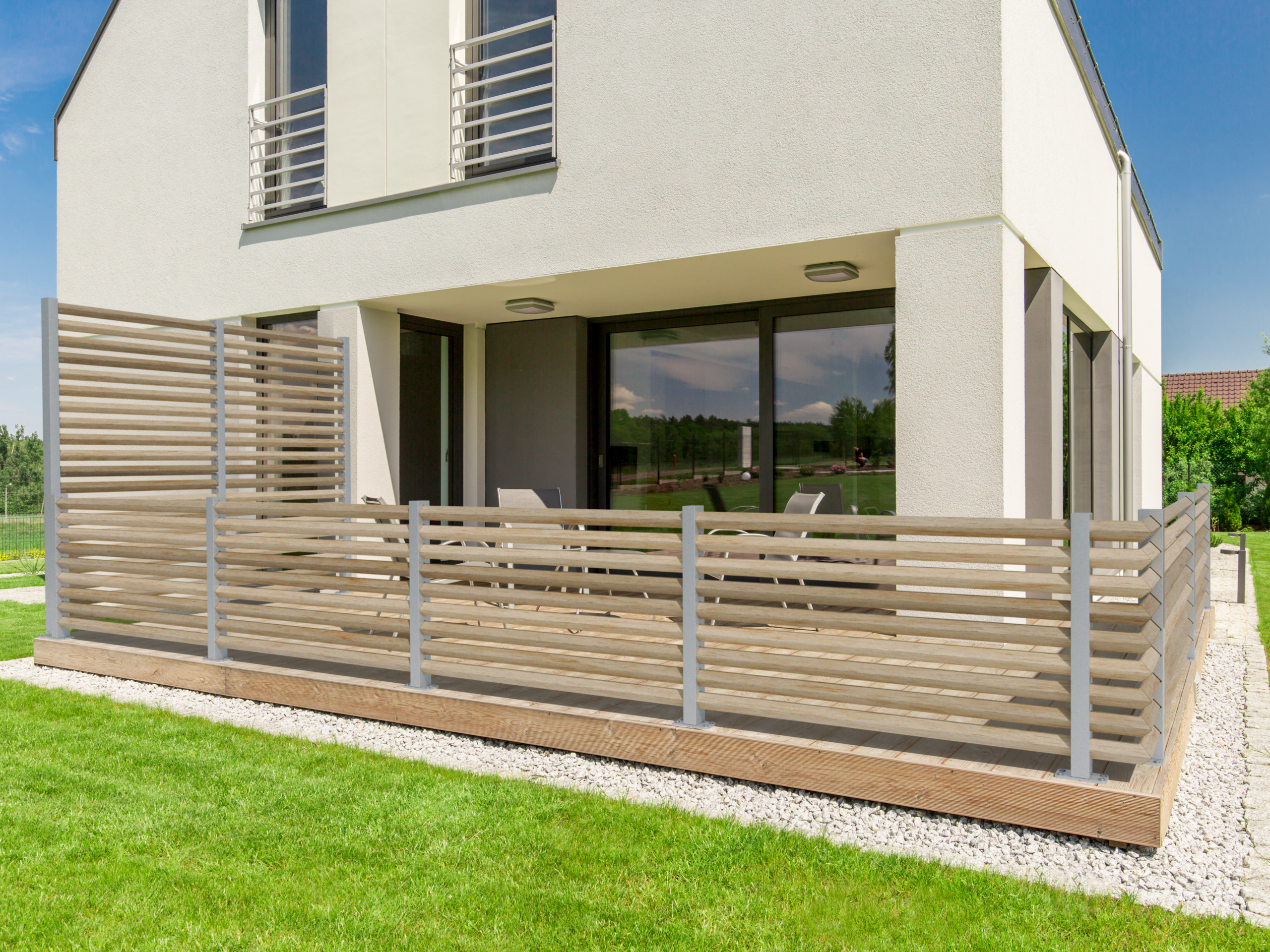
A slatted fence creates an airy and clearly defined framework in the garden by marking boundaries and different areas without enclosing the space. The gaps between the slats allow light and air to pass through and create a more open look than a solid fence.
Four factors primarily influence the result: height, spacing between the slats, the orientation of the slats, and the material. These factors determine how open the fence feels, how much overlooking it prevents, and how well it blends in with the house and garden.
In this guide, we’ll walk you through the choices – from function and placement to height, slat spacing, materials, and final dimensions – so you can plan a slatted fence that both frames the garden and allows it to retain its sense of openness.
What height should your slatted fence be?
The height depends on the intended use of the slatted fence. For low edging along paths and plantings, 40–60 centimetres may be sufficient, while 80–100 centimetres provides a clearer boundary, for example, around a property boundary.
Whether the fence is intended to provide more privacy or to be used as a balustrade on a deck or in another location with a risk of falling, its height and design must be adapted to the location's function and conditions.
| Height | Function | To check |
|---|---|---|
| 40–60 cm | Used to mark paths, flower beds, and garden beds. | Check for any placement restrictions if the fence is located near a boundary or another sensitive location. |
| 80–100 cm | Provides a clear property boundary without blocking the view of the garden. | Check what requirements may apply to the location and design of the site where the fence is to be built. |
| Customised | Can be used on a deck or where there is a difference in level, where the structure also needs to serve as a fall protection. | The height and design must be adapted to the safety requirements that apply at the specific location. |
| 140–180 cm | Provides more privacy, for example, on a patio or in a lounge area. | Taller and denser structures may be subject to special regulations or permitting requirements. |
Check the regulations for taller or denser structures
How a slatted fence is assessed can be influenced by factors such as height, density, location, and function. A taller or denser structure may therefore be subject to different requirements than a low, open fence.
Regulations and any permit requirements may vary depending on where the structure will be located. Therefore, always check the requirements that apply to the specific location before building a taller or denser slatted fence.
How do you choose the slat spacing and direction on a slatted fence?
Choose vertical slats when you want a distinct vertical look, better water drainage, and a design that is harder to climb on. The horizontal version slats provide a wider and more architectural look. The spacing between the slats determines how open fence feels: narrow gaps provide more privacy, while wider gaps let in more light and air.
| Property | Vertical slats | Horizontal slats |
|---|---|---|
| Visual impression | Enhances height and creates distinct vertical lines. | Visually widens the space and creates a more architectural look. |
| Climbing | More difficult to use as a foothold. | Slats can serve as footholds. |
| Water drainage | The water flows along the slats. | More horizontal surfaces can trap moisture. |
| Wind | It is primarily influenced by the distance between the slats. | It is primarily influenced by the distance between the slats. |
| Best for | When you want vertical lines and a design that's less climbable. | When the visual effect and horizontal lines matter most. |
How does the spacing between the slats affect privacy?
The smaller the distance between slats, the more secluded the space becomes. A larger gap provides more transparency and a more airy feel.
Creates a dense, enclosed look with very little overlooking and is ideal for places where privacy is paramount.
It strikes a balance between privacy, light, and air while the slatted fence retains its open character.
It lets in more light and provides better visibility, creating an airy look, but offers considerably less privacy.
Which is better for a slatted fence – timber or aluminium?
Timber is best suited when you want a warm, natural look and are willing to treat the surface periodically. Aluminium requires less ongoing maintenance and is particularly well-suited for posts and other parts exposed to high levels of moisture. The materials can also be combined in the same slatted fence.
| Property | Timber | Aluminium |
|---|---|---|
| Appearance | Creates a warm and natural look that pairs well with greenery and other timber accents. | Creates a sleeker, more modern look with clean lines. |
| Maintenance | Should be inspected regularly and may need to be oiled, treated with timber stain, or painted, depending on the type of timber and the finish. | It usually needs to be cleaned primarily to remove dirt and deposits. |
| Moisture | Must be protected from prolonged exposure to moisture and should not be placed unprotected directly on the ground. | It does not rot and is therefore well-suited for posts and other structural components in close contact with the ground. |
| Dimensional stability | Timber is a living material and can expand and contract as temperature and humidity levels change. | Retains its shape without the same type of moisture-related movement as timber. |
| Cost | It often has a lower purchase price, but recurring surface treatments affect maintenance over time. | Often has a higher purchase price but requires less recurring surface treatment. |
| Best for | When the natural feel of timber is important and you're willing to maintain the material regularly. | When you prioritise a sturdy design and less ongoing maintenance. |
Aluminium where wear is most severe, timber where the character stands out
Aluminium posts can be combined with timber slats or a timber top rail. This reduces the amount of timber placed close to the ground, while still retaining the warm, natural feel of timber in the parts that are most visible.
With the Verto post system, aluminium posts can be combined with any type of timber and customised to match the fence's dimensions and style.
Where is a fence most useful?
A slatted fence rarely needs to surround the entire property. It’s most useful where you actually need a clear boundary, privacy screening or shelter from the wind. By placing the fence where it’s needed, you’ll achieve a more pronounced effect with less material.
- By the deck
- A slatted fence can define the boundaries of the deck and create a clearer transition between the deck and the garden. If the structure is also intended to serve as a balustrade, its height and design must be adapted to the safety requirements of the location.
- Along the walkway
- A low section, about 40–60 centimetres high, can frame a path and guide movement through the garden without obscuring the planting next to it.
- At the property boundary
- Here, a slatted fence can create a clear boundary without feeling as enclosed as a solid fence. The height and spacing between the slats can be adjusted depending on how much privacy, visibility, and wind protection you want.
- As a garden divider
- A short section of fencing can be enough to separate, for example, a lounge area, dining area, or barbecue area from the rest of the garden and create more distinct zones.
- Around the growing area
- A lower slatted fence can define the planting area, provide support for climbing plants, and at the same time create a clear boundary between walkways or the lawn.
How do you plan a slatted fence in the garden?
Start by deciding where to place the fence and what function it will serve. Next, choose the height, spacing between the slats, orientation, and material, and finally, check the regulations and any permit requirements, as well as the final dimensions.
Go through these seven points
-
Observe the garden at different times
See where the shade falls, where the wind is coming from, and from which directions you want to prevent overlooking. Conditions can change significantly throughout the day.
-
Mark out the fence temporarily
Place stakes and string a line where the fence will stand. Also mark the intended height so you can assess the proportions on site.
-
Determine the function before the height
Determine whether the slatted fence is primarily intended to mark a boundary, improve privacy, block the wind, or serve as a barrier across a difference in elevation. Its function determines the appropriate dimensions and design.
-
Choose the slat spacing based on the desired level of privacy
Smaller gaps provide more privacy. Larger gaps let in more light and offer better visibility, giving the fence a more open feel.
-
Determine the direction of the slats
Vertical slats create distinct vertical lines and are more difficult to climb. Horizontal slats broaden the visual impact but can serve as rungs.
-
Check the regulations and any permit requirements
The applicable requirements may depend on the structure's height, density, function, and location. Therefore, check what applies at the specific site before you build or place an order.
-
Measure the final dimension carefully
Check the length of the run, any changes in level, and any corners before you place your order. Made-to-measure sections must be based on the actual measurements at the site.
First, plan the function and placement. Once those are determined, it will be easier to choose the height, slat spacing, orientation, and materials, and to measure fence correctly before placing an order.
Which slatted fence is best suited to your garden?
Once you've decided on the location, height, and how open the fence should be, you can compare different slatted-fence options. If you need help with choosing materials or dimensions, you can also contact customer service.
What do you need to know about slatted fences in the garden?
Here are some quick answers about height, slat spacing, regulations, materials, placement, and safety when planning a slatted fence.
How tall should a slatted fence be at a property boundary?
A slatted fence measuring about 80–100 centimetres can provide a clear property boundary without blocking the view of the garden as much as a taller structure. If you need more privacy, the height can be increased, but always check the rules regarding height, design, and placement at the specific location.
When do you need to check the rules for a slatted fence?
The applicable requirements may depend on factors such as the fence’s height, density, function, and location. Taller or denser structures may be subject to different regulations or permit requirements, so be sure to check what applies at the specific location before you begin construction.
How much space should there be between the slats in a fence?
A gap of 10–15 millimetres creates a dense appearance with very limited visibility. A gap of about 20–30 millimetres provides a better balance between privacy, light, and air, while a gap of 40–60 millimetres creates a significantly more open slatted fence.
Can you have horizontal slats by a pool or where there is a risk of falling?
Horizontal slats can act as footholds and should therefore not be used as the primary safety barrier where the fence is intended to prevent climbing or provide protection near a pool or where there is a risk of falling.
Which material requires the least maintenance for a slatted fence?
Aluminium generally requires less ongoing maintenance than timber because it does not need to be oiled, stained, or painted in the same way. Wood, on the other hand, has a warmer look and may be the right choice when the feel of the material is more important than low maintenance requirements.
Does a slatted fence have to go all the way around the lot?
No. A slatted fence can be placed exactly where it’s needed – for example, by the deck, along a walkway, at property boundary, or as a room divider. A shorter section is often enough to create a clear frame or reduce visibility.
Can timber and aluminium be combined in the same slatted fence?
Yes. Aluminium can be used for posts and other exposed structural components, while timber is used for slats or top rail. This results in a more durable frame while slatted fence retaining the warmer look of wood.