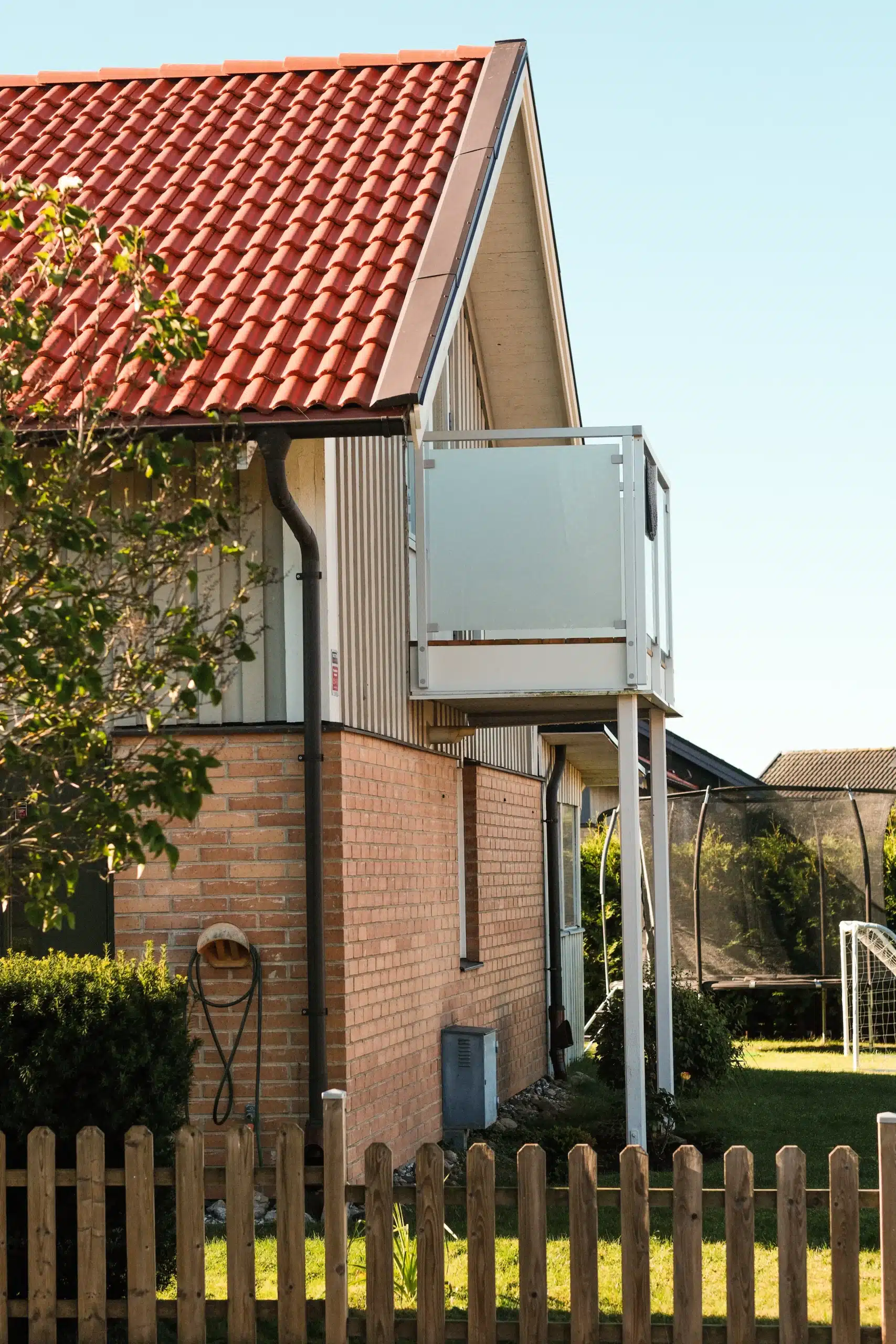
Glass and stainless steel balustrades are the best choice when you want to preserve light and views while still having a durable metal structure with a minimalist look. The glass creates an open feel, while the stainless steel is used in fixings and other details that hold the balustrade together.
This combination works both indoors – on staircases and in lofts – and outdoors on decks and balconies. Outdoors, the choice of steel grade is particularly important, since salt, chlorides, and moisture affect how well the steel stainless withstands the environment over time.
In this guide, we’ll go over the differences between the various grades of stainless, the types of glass available, how fixing affects both appearance and construction, and what you need to consider regarding regulations and maintenance.

What is the difference between AISI 304 and AISI 316L in a balustrade?
AISI 304 is primarily suitable for dry indoor environments, while AISI 316L is better suited for outdoor use and in environments containing salt or other chlorides. The difference is primarily due to the fact that 316L contains molybdenum, which improves corrosion resistance.
When comparing a stainless steel balustrade, it is therefore important to check the exact steel grade and not just rely on the material being described as stainless steel.
| Quality | Best for | What sets it apart |
|---|---|---|
| AISI 304 | Indoors Stairs, loft, and floor levels | Good corrosion resistance in dry environments, but does not contain molybdenum. |
| AISI 316L | Outdoors Coastal, pool, and salt-exposed environments | Contains molybdenum, which provides better resistance to salt and other chlorides. |
Why does 316L perform better in outdoor environments?
Stainless steel is iron mixed with other substances to achieve certain properties. This mixture is called an alloy. The key difference here is that 316L contains molybdenum, while 304 does not.
Good corrosion resistance indoors
AISI 304 works well for stairs, lofts, and other balustrade applications where the steel is not regularly exposed to salt or other chlorides.
Improves the steel’s resistance to salt
Molybdenum improves the steel's resistance to chlorides. Chlorides are found, for example, in sea salt, swimming pools, and road salt, and can otherwise cause localised corrosion on the steel's surface.
Better suited to coastal, poolside and salt-exposed environments
That is why 316L is better suited for an outdoor stainless steel balustrade. The extra protection reduces the risk of pitting corrosion when the steel is exposed to salt and other chlorides.
Which glass should you choose for a glass balustrade?
All of our glass balustrades use laminated safety glass. This means that two glass panels panes are held together by a film between them – a design that is particularly important when the balustrade serves as fall protection.
The interlayer helps hold the glass together if a pane breaks
If a laminated glass panel breaks, the film helps hold the glass fragments together. This reduces the risk of an open gap forming right where the window pane was.
Toughened glass used without lamination behaves differently: when broken, the glass shatters into many small pieces and may leave the opening unobstructed. Therefore, the glass’s construction must always be chosen based on how the balustrade will be used.
Choose the type of glass based on what you want to preserve – or screen out
The safety function does not have to dictate the appearance of the glass. The same laminated design can be combined with different styles depending on how much of a view, light, and privacy you want.
Maximum light and completely unobstructed views. The standard choice when the view is an important part of your deck, balcony, or terrace.
Dims the light and provides some privacy without completely blocking the view. It's ideal when you want to maintain visibility but create a darker, more defined look.
Frosted glass that breaks the line of sight but still lets light through. A good choice when a neighbour is nearby or when part of the balustrade needs to provide more privacy screen.
Clear, grey-tinted, and “opal” primarily describe the appearance of the glass. The lamination is what helps the pane stay intact in the event of breakage, while the entire balustrade’s construction – glass, fixing, and dimensioning – together determine how fall protection functions.
Which fixing method should you choose for a glass balustrade?
Choose glass clamps when you want a clear and easy-to-install solution with visible hardware and stainless posts. Point mounting, often referred to as “fixpoints,” is a better fit when you prioritise a more minimalist look and have a load-bearing surface that can support the more concentrated loads.
The classic and easy-to-install choice
Glass clamps hold the glass in place with visible hardware. This solution is durable, easy to install, and works particularly well on straight sections of balustrade with stainless posts.
Easy to install and adjust
Visible fittings around the glass
Goes well with stainless posts
A cleaner look – greater structural demands
Fixpoints secure the glass at individual points. This solution provides a more minimalist look, but requires that both the glass and the load-bearing substrate be designed to withstand the point loads.
Less visible fixing around the glass
A cleaner, more minimalist look
Requires the right glass and a load-bearing substrate
Regardless of which fixing you choose, the balustrade must be anchored to a surface capable of supporting the load. With point fastening, this becomes especially important because the load is concentrated at fewer and more localised attachment points.
Top rail or exposed glass edge?
The top rail primarily affects the grip, the feel, and how well the top edge of the glass is protected. Without a top rail, the balustrade takes on a cleaner look, but the glass then has to bear more of the load on its own.
Provides a natural grip and protects the top edge of the glass. It is especially practical on stairs and in places where people often lean against the balustrade.
Creates a more minimalist look without a profile along the edge of the glass. At the same time, the glass must be dimensioned to bear a larger portion of the load on its own and is therefore often thicker.
What are the rules for glass balustrades?
A glass balustrade designed to provide protection against falls must be tailored to the risks at the specific location. Requirements regarding height, glass, openings, fixing, and load-bearing structures may vary depending on where the balustrade is to be installed and how it will be used.
The balustrade must also be designed to withstand the load that could occur if a person falls or collides with it. Therefore, the entire balustrade structure – not just the glass – must be evaluated based on its intended use and the height of a potential fall. Always check the current guidelines from your local authority or the relevant body.
What are the requirements for areas where young children can play?
In areas where young children are present, the design of the balustrade must specifically prevent climbing, falling through openings, and the risk of a child becoming trapped. Specific requirements regarding openings and spacing may vary depending on the location.
The balustrade should not provide an easy way for the child to climb up
Horizontal sections, protruding parts, and other potential footholds must be evaluated to ensure that the balustrade is not easy to climb.
The openings need to be adapted to meet safety requirements
Check the maximum clearance requirements for the location where the balustrade will be installed. This applies both between different sections of the balustrade and at connections to other structures.
Assess both the size and shape of the openings
Avoid openings and gaps where a child could get their head or other parts of their body stuck. Check the requirements that apply to the specific location.
The opening under the balustrade also needs to be assessed
Check the distance between the bottom edge of the balustrade and, for example, the balcony floor, landing, or stair tread. Permissible opening dimensions may vary depending on the design and location.
How much maintenance does a glass balustrade with stainless steel posts require?
A glass balustrade with stainless steel posts requires relatively little routine maintenance. For the stainless parts, regular cleaning goes a long way, but in coastal areas and other locations exposed to salt, the balustrade needs to be rinsed and wiped down more often.
A few times per season
In coastal areas and other locations exposed to salt, it's a good idea to clean more often to remove salt and other deposits.
Water and a soft cloth
Wipe down the stainless parts so that dirt, salt, and other deposits do not remain on the surface.
Clean more frequently
Salt exposure is greater near the sea, which means that the balustrade needs to be rinsed and dried more often than in a less exposed environment.
Steel wool and chlorine-based agents
They are unsuitable for stainless steel because they can affect the surface and increase the risk of corrosion.
What should you check before choosing a glass balustrade in stainless steel?
Start with the environment where the balustrade will be installed, and then move on to the glass, fixing, and construction. The checklist will help you distinguish between the technical requirements and the choices that primarily affect the balustrade's appearance.
Go through these seven points
-
Should the balustrade be inside or outside?
The location determines which steel grade is suitable. Outdoors, the stainless steel is exposed to much more moisture, salt and other chlorides than in a normal indoor environment.
-
Have you chosen the right grade of steel for the environment?
Choose 316L for outdoor use, especially in coastal areas, around pools, and other environments where the balustrade is exposed to salt or chlorides.
-
How much of a view and how much privacy do you want?
Choose clear glass for an unobstructed view, grey-tinted glass for a darker look, or opal glass when you want to create more privacy but still let light through.
-
Which is best – glass clamps or point fixings?
Glass clamps provide a straightforward, easy-to-install design. Point fixings, or fixpoints, offer a more minimalist look but concentrate the load at fewer fixing points.
-
Would you like a top rail or an exposed glass edge?
A top rail provides a natural grip and protects the top edge of the glass. Without a top rail, the look is cleaner, but the glass needs to be sized appropriately for that solution.
-
Can the supporting structure withstand the load?
The fixing must be anchored to a load-bearing structure. This is particularly important in the case of point fastening, where the load is concentrated on smaller areas.
-
Can the water drain away and the structure dry out?
Check joints and fixings to ensure that water does not pool in confined spaces. A design that allows for ventilation and drying reduces the risk of corrosion problems over time.
The environment, materials, glass, and fixings need to work together. When the technical conditions are right, it also becomes easier to choose the look you want without compromising on durability or function.
Which glass balustrade is the best fit for your environment?
Start by considering where the balustrade will be installed, how exposed the environment is, and what look you want. Customer service helps you compare the options and check the dimensions before you order.
Frequently asked questions about glass balustrades in stainless steel
Here we answer frequently asked questions about steel quality, safety glass, fixing, top rail, child safety, the pool environment, and maintenance.
Can you use AISI 304 outdoors?
AISI 304 is particularly suitable for drier indoor environments. Outdoors, and especially near the coast, a pool, or other environments exposed to salt, the risk of corrosion increases. In such cases, AISI 316L is a better choice.
What happens if laminated glass breaks in a glass balustrade?
The film between the glass panes helps hold the glass pieces together if the glass breaks. This reduces the risk of an open gap forming right where the glass panel was.
Does a point-fixing system need to be attached to a load-bearing substrate?
Yes. Point fastening concentrates the load onto smaller fastening points, which makes it especially important that the fixings reach a load-bearing structure and that both the glass and the substrate are dimensioned for this solution.
Does a glass balustrade need a top rail?
No. A top rail provides a natural grip and protects the top edge of the glass, but glass balustrades can also be designed with an exposed glass edge. Without top rail, the glass and the rest of the structure must be dimensioned for that solution.
Is a glass balustrade appropriate for places where young children are present?
An unbroken glass panel has no openings or natural climbing steps on the front itself. The bottom edge, fixings, and the rest of the balustrade’s design must also meet the requirements that apply in areas where young children may be present.
Is a glass balustrade with stainless steel posts suitable for use around a pool?
Yes, but the steel grade needs to be suited to the environment. For swimming pools, AISI 316L is better suited because chlorides make the environment more demanding for stainless steel.
How do you clean a glass balustrade with stainless steel posts on the coast?
Wipe down the stainless parts with water and a soft cloth, and clean them more often than you would in environments with less salt exposure. Avoid steel wool and chlorine-based cleaning products.