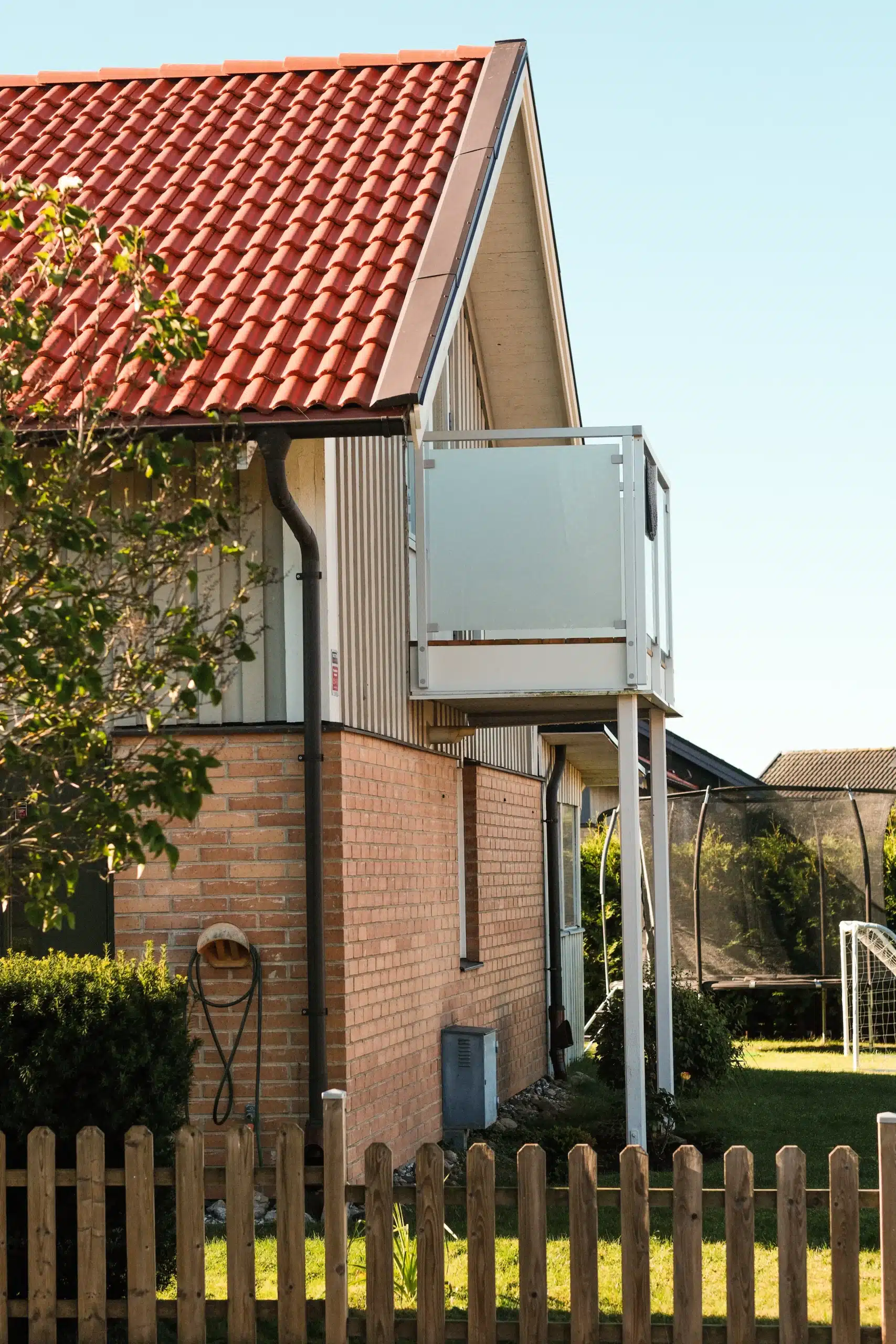
A fence with vertical slats defines the seating area without making it feel enclosed. The vertical lines give a calm, modern look and make it easy to control how open or screened the fence should be.
When you choose a slatted fence, the spacing between the slats is at least as important as the material itself. Closer spacing gives more privacy and breaks the wind more, while wider gaps give a lighter look and let more of the surroundings through.
In this guide we compare aluminium and timber, go through slat spacing, height and child safety, and show what to think about when vertical slats are used on a deck, a terrace or as a boundary in the garden.
What slat spacing works best for a fence with vertical slats?
Spacing of around 10–15 mm creates a very close screen; 20–30 mm offers a better balance between privacy and openness, while 40–60 mm creates a much more open appearance. The best spacing therefore depends on whether you mainly want screening or prefer to retain more light and visibility.
When choosing a slatted fence, the distance must also be assessed in conjunction with the fence’s height, location, and any function it may serve as fall protection.
| Slat Spacing | Visual effect | Best for |
|---|---|---|
| 10–15 mm | Closely spaced slats providing a high degree of privacy | Facing a street, a walkway, or a nearby neighbour |
| 20–30 mm | Balance between openness and privacy | Deck, patio and garden |
| 40–60 mm | A more open look and greater transparency | Decorative border around a seating area or garden |
Which material is best for a slatted fence – aluminium or timber?
Aluminium is the best choice when you want a durable slatted fence that requires little ongoing maintenance, while timber is the better option when the feel of the material and a warmer aesthetic are more important. The biggest practical difference over time is that timber requires periodic surface treatment, whereas powder-coated aluminium mainly needs to be cleaned.
| Comparison | Aluminium, powder-coated | Timber, pressure-treated |
|---|---|---|
| Maintenance | Wash as needed; normally does not require painting or oiling | Requires periodic oiling, painting or other surface treatment |
| Service life | Can provide a long service life with the right design and maintenance | Is clearly affected by moisture, surface treatment, and how the timber is installed |
| Moisture and locations close to the ground | Does not rot and is therefore well-suited for exposed outdoor environments | Moisture and contact with the ground increase the risk of rot damage |
| How the surface changes over time | Powder-coated surface requiring little ongoing maintenance | The surface changes with the weather and usually needs to be retreated |
| Appearance | Modern and minimalist | Warm and more traditional |
| Cost considerations | Material costs are often higher from the start | May have lower initial material costs but requires more ongoing maintenance |
How tall should a fence with vertical slats be?
There is no single height that works for every slatted fence. A lower fence may be sufficient to mark a boundary, while a taller fence is needed when the goal is greater privacy. If the structure is also intended to prevent falls, the height and overall design must be assessed based on the risk of falling and how the space is used.
If your main goal is privacy screening for a patio, you therefore need to consider both the height of the fence and how closely the vertical slats are spaced.
- Boundary
- When a slatted fence is primarily intended to define a property boundary, a deck, or a section of the garden, the height can be chosen based on proportions, visibility, and how clearly defined you want the boundary to be. A lower, more open fence maintains a closer connection with the surroundings.
- Privacy and wind
- For greater privacy, a slatted fence generally needs to be taller and have closer spacing than one used simply to mark a boundary. Height determines which parts of the sightline are screened, while slat spacing affects how much you can still see through the fence and how much air can pass through.
- Fall protection
- On a raised deck or terrace, the structure must provide protection against falls. Height, openings, stability, and fixing must then be assessed based on drop height, how the space is used, and the safety requirements the structure must meet.
Should you choose vertical or horizontal slats for your fence?
Vertical slats give a calm, vertical look and make it easier to avoid horizontal parts that can be used as footholds for climbing. Horizontal slats instead emphasise the width of the fence and give a clearer horizontal design. Which option suits best depends on both the style of the house and how the fence will be used.
Vertical slats
Vertical design with fewer horizontal climbing surfaces
Vertical slats emphasise height and give the fence a calm, regular appearance. As the slats run vertically, they do not create the same obvious horizontal footholds as horizontal slats.
The style works well on decks and in gardens where you want a clear boundary without the fence feeling heavy. On timber structures, water can also run down the slats without long horizontal top surfaces.
Horizontal slats
A horizontal design that emphasises the width of the fence
Horizontal slats emphasise width and can create a more architectural look, particularly on long stretches of fencing or where the building façade already has strong horizontal lines.
Horizontal slats can also provide footholds that make climbing easier. On timber, even the horizontal surfaces need to be designed and maintained with the understanding that dirt and moisture can accumulate there more easily.
How can you make a slatted fence fit with the rest of your outdoor space?
Start from the lines, materials and colours already found around the house. When fence, balustrade, gate and other details clearly relate to each other, the outdoor space feels more cohesive without everything having to be identical.
- Match your balustrade and fence
- Choose the same colour or recurring materials on the fence and the decking balustrade. That creates a clear common thread even though the structures have different functions.
- Gate
- A gate in the same colour and with a design that complements the fence creates a natural transition without disrupting the overall look. At the same time, consider the direction of opening, the width, and how the gate is used in everyday life.
- Lighting
- Subtle lighting along the fence can highlight walkways and edges while adding depth to the patio in the evening. Position the lighting so that it aids navigation without causing glare.
- Plants
- Plantings in front of or next to the slatted fence can soften the straight lines and create a contrast with aluminium or wood. At the same time, leave enough space around the structure for cleaning and routine maintenance.
How do you choose the right fence with vertical slats?
Start by deciding what the fence needs to do and assessing the conditions on site. Once you have considered the risk of falling, slat spacing, materials, height and measurements, it becomes much easier to choose a slatted fence that works both practically and visually.
Six things to decide before choosing your fence
-
What is the fence meant to solve?
Decide whether the main purpose is to mark a boundary, improve privacy, provide shelter from the wind or prevent falls. That will influence the height, slat spacing and design.
-
Is there a risk of falling?
On a raised deck or terrace, the height, openings, and other design features must be evaluated based on the risk of falling and how the space is used.
-
What is the appropriate slat spacing?
Closer slats give more screening, while wider gaps make the fence lighter and easier to see through. If the structure also acts as fall protection, the openings must meet the safety requirements too.
-
How much maintenance do you want?
Aluminium requires relatively little ongoing maintenance, while timber has a warmer feel but needs periodic surface treatment.
-
Have you checked to see if a permit is required?
A tall fence with closely spaced slats may be subject to planning permission or other approvals. Check what applies at your location before settling on the dimensions and design.
-
Have you checked the measurements along the entire fence line?
Check the lengths, corners, level differences, and mounting points before ordering a custom-made fence.
Which slatted fence is right for your outdoor space?
Start by considering how much you want to block the view or reduce visibility, whether there is a drop height, and how much maintenance you want. Once you’ve made those decisions, it will be easier to choose the right slat spacing, height, and material for the fence.
What do you need to know about fences with vertical slats?
The most common questions concern slat spacing, privacy, materials, height and safety. Here are brief answers to help you plan and choose a slatted fence for your outdoor space.
How far apart should vertical slats be?
It depends on how much privacy you want. Around 10–15 mm creates a close screen, 20–30 mm balances privacy with openness and 40–60 mm gives a more open appearance. These are design examples, not general safety limits for fall protection.
Does a fence with vertical slats provide good privacy?
Yes, especially when the slats are closely spaced. How much privacy the fence provides also depends on its height, the width of the slats and the angle of view. A closely spaced slatted fence can offer good privacy without making the patio feel completely enclosed.
Which is better for a slatted fence – aluminium or timber?
Aluminium is a good choice if you want a durable fence that requires little ongoing maintenance. Timber provides a warmer, more traditional look but typically requires periodic refinishing. The choice depends mainly on the look and feel of the material you prefer and how much maintenance you’re willing to put into it over time.
How tall should a fence with vertical slats be?
The height depends on the fence’s function. A lower slatted fence may be sufficient to mark a boundary, while a taller option provides more privacy. If the structure is intended to prevent falls, the height, stability, and other design features must be adapted to drop height and how the site is used.
Can a fence with vertical slats serve as fall protection?
Yes, if the structure is sized and designed to function as fall protection. Vertical slats do not offer the same clear climbing opportunities as horizontal slats, but openings, height, fixing, and stability must also meet the safety requirements for the intended use.
Do I need a permit for a tall slatted fence?
A tall or dense slatted fence may require a permit or other approval. Height, location, transparency, and how the structure affects its surroundings may be factors. Therefore, check the requirements before deciding on the fence’s final dimensions and design.
What do I need to measure before ordering a slatted fence?
Measure the entire fence line and check corners, changes in level and suitable fixing positions. Decide on the height and slat spacing too. If the fence will connect to a gate, balustrade or existing structure, plan those junctions as well.