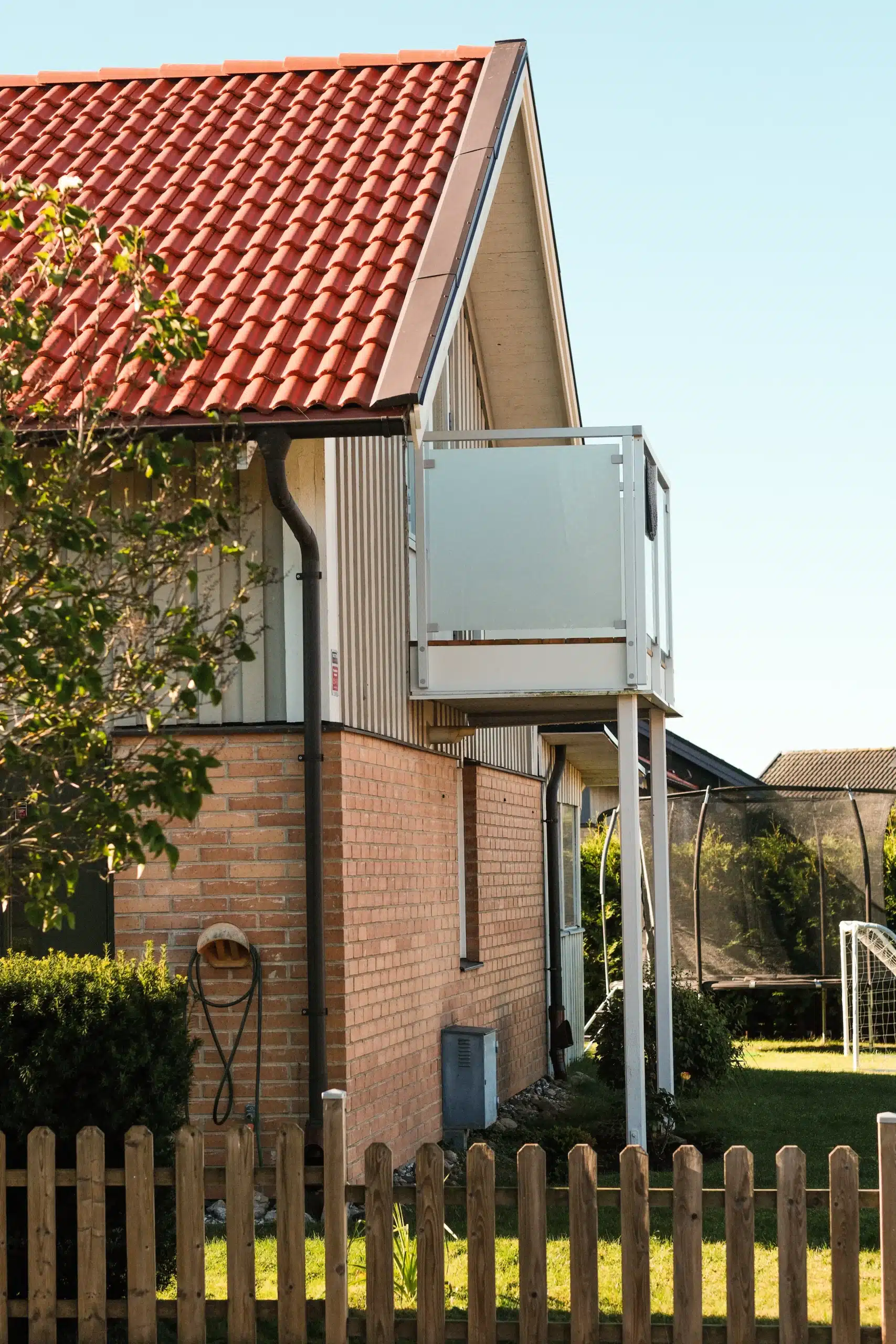
A wire balustrade can be a safe balustrade solution when it is properly sized, anchored, and adapted to the location. Horizontal wires, on the other hand, can provide children with a foothold and therefore need to be evaluated carefully where there is a risk of falling.
Safety involves more than just the distance between wires. The height of the balustrade, openings, fixings, and wire tension all affect how the structure functions. In areas where children are present, you also need to consider the risk of them climbing on, falling through, or crawling under the balustrade.
In this guide, we’ll go over what you need to check, which environments are suitable for wire balustrades, and when a different balustrade design might be a better choice. Before placing an order, you also need to ensure that the solution meets the requirements for the specific location and complies with the product’s assembly instructions.
Why can horizontal wires pose a climbing hazard?
Horizontal wires can serve as footholds and make it easier for children to climb a balustrade. Therefore, you need to assess the balustrade’s climbability when children may be present, especially if the balustrade protects against a fall from a higher level.
Wires can be used as a step
When wires are within reach, children can use them to gain a foothold and climb higher up the balustrade. This can increase the risk of them climbing over the balustrade, even if the distance between wires is small.
Reduce the ability to climb
In areas where children are present, vertical bars or glass panels, for example, may be more appropriate because they do not provide the same natural foothold. Even such solutions must be designed with the appropriate height, safe openings, and stable fixing.
What should you check to make sure a wire balustrade is safe?
A wire balustrade must work as one complete structure. It is not enough for the wires simply to look closely spaced. The size of the openings, how much they can deform under load, the height of the balustrade and how the structure is anchored also affect safety.
When planning a wire balustrade, it is therefore important to consider several factors together. Start with the location’s drop height and intended use, who will be using the area, and what requirements the balustrade design must meet.
| Checkpoint | What you need to check | Why It's Important |
|---|---|---|
| Gaps between wires | Check the clearances when wires are properly tensioned. Also assess whether the clearances might increase when wires are loaded or pushed apart. | Openings that are too large or changeable can impair fall protection and pose a risk to anyone using the site. |
| Climbability | Check whether wires or related details can be used as footholds, especially in areas where children may be present. | Horizontal wires can make climbing easier and make it possible to get higher up on or over the balustrade. |
| Balustrade height | Determine the required height based on the site's drop height, intended use, and the applicable design requirements. | A balustrade that is not high enough may provide insufficient protection against falling over the edge. |
| Wire tension | Make sure that the wires are installed and tightened according to the system instructions. Also make sure that the tension can be checked after installation. | Wires with insufficient tension can cause larger gaps and impair the balustrade’s protective function. |
| Posts and fixings | Check the post spacing, fixings and ensure that the balustrade is mounted on a load-bearing surface that is suitable for the system. | Both the tensile force of the wire and the loads to which the balustrade is subjected must be able to be absorbed by the entire structure. |
| Condition and maintenance | Inspect wires, tensioners, and fixings regularly. Retighten as needed and repair any damage or corrosion according to the product instructions. | Wear, corrosion, and changes in wire tension can affect the safety of the balustrade over time. |
How can a wire balustrade be used in settings where young children are present?
In areas where young children are present, the climbability of the balustrade must be assessed carefully. Two options are to combine wire with a smooth infill that reduces the ability to gain a foothold, or to choose vertical bars instead. Both solutions must be designed with consideration for the balustrade’s height, openings, fixings, and the intended use of the space.
Combine wire with a plain infill
A smooth surface, such as glass, can make it harder to use the lower parts of the balustrade as footholds. If wires are placed higher up, you still need to assess whether they can be reached and used when climbing.
Glass or another continuous infill can reduce the number of footholds. Also check the openings and how the infill is fixed.
Determine whether wires can be accessed from the floor, furniture, or other nearby objects. The size of the openings and how they are affected by loads must also be checked.
A combination can preserve much of the wire balustrade’s airy appearance while reducing certain climbing risks. However, it is only suitable if the entire structure provides sufficient fall protection and meets the safety requirements for the location.
Select vertical bars
Vertical bars do not normally provide the same natural foothold as horizontal wires and may therefore be a more suitable option in areas where small children are present. The spacing, height, and fixings of the balustrade still need to be checked.
In areas where young children are regularly present, vertical bars may be easier to design to be less climbable. The finished balustrade must still be inspected as a whole before it is put into use.
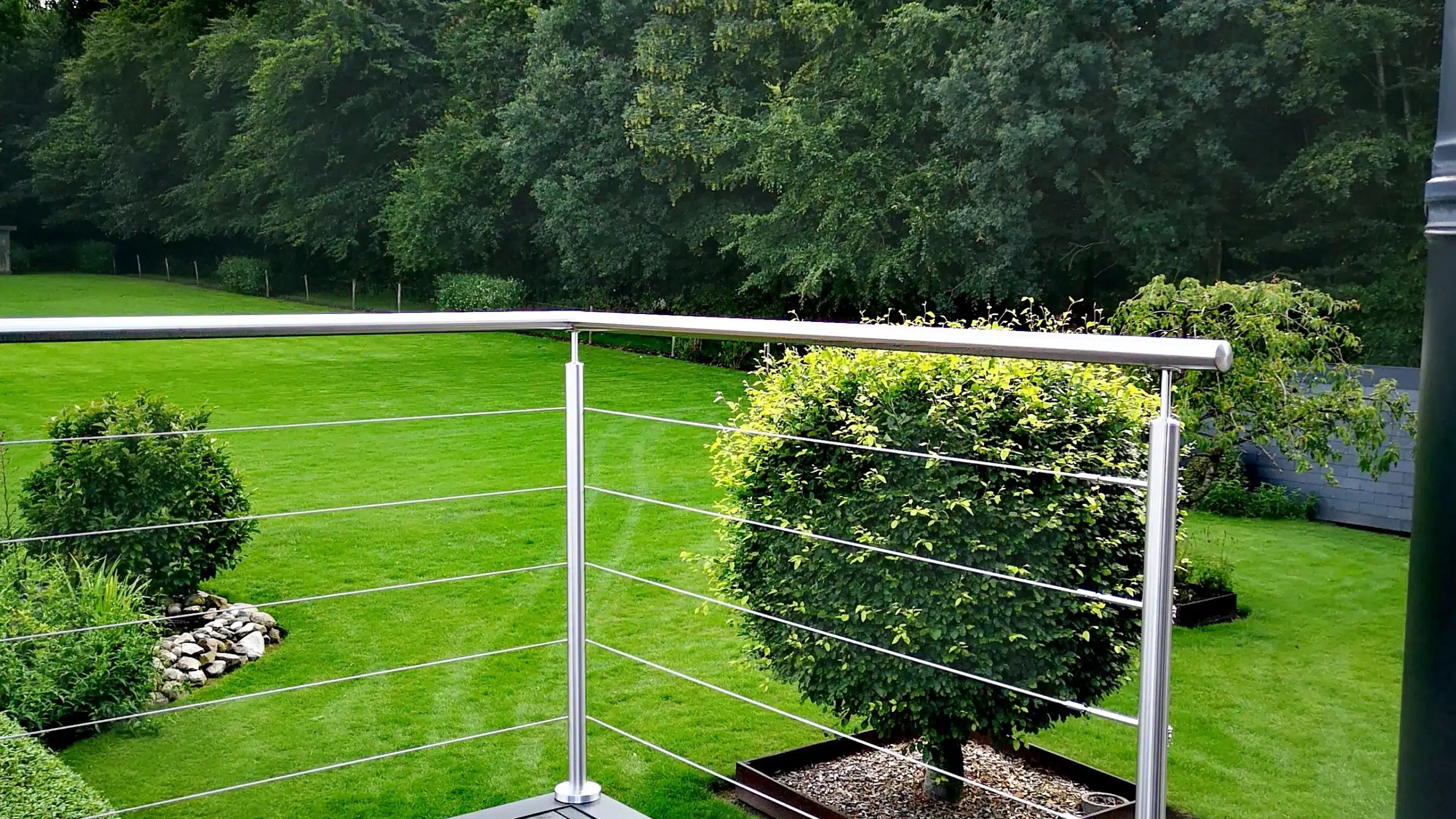
Where does a wire balustrade fit best?
Wire balustrades are best suited for locations where an unobstructed view and a light, airy appearance are important, and where the design also meets the needs of those who use the space.
Particularly well suited
In gardens, on low decks and around patios close to ground level, where the balustrade mainly acts as an open boundary. On jetties and raised areas, the risk of falling and the protective function of the balustrade must be assessed carefully.
The biggest advantage
The slender wires provide an unobstructed view and have a minimal visual impact compared to denser balustrade solutions.
In a coastal environment
Marine-grade stainless steel, AISI 316L, is a suitable material choice in many coastal environments. Verify that wires, posts, and fixings are all designed for the specific exposure to moisture and salt.
How does a wire balustrade work on stairs?
A staircase balustrade can be designed with wires that follow the pitch of the stairs. In systems with continuous wire, the wire is fixed to the end posts and runs through the intermediate posts. How posts and wires are installed depends on the balustrade system.
Continuous wire follows the pitch of the stairs
-
End posts at the beginning and end of the wire run
The end posts serve as the fixed end points of the wire and must be anchored in accordance with the balustrade system's assembly instructions.
-
The intermediate posts guide the wire
In a continuous-wire system, the wire runs through eyelets in the intermediate posts instead of ending and starting again at each post.
-
The wire follows the slope of the stairs
The continuous wire follows the angle of the stairs between the lower and upper end posts.
How can you customise a wire balustrade for your location?
A wire balustrade can be customised based on the number of wires, the choice of top rail, how the wire is installed, and the balustrade’s total height. Together, these choices affect both the appearance and how the balustrade functions in its location.
Number of wires
Fewer wires create a more open look, while more make the balustrade denser. The number also affects the opening size and therefore needs to be planned in conjunction with the balustrade’s height.
Top rail
A top rail made of stainless steel creates a clean and uniform look, while timber such as oak or jatoba gives the balustrade a warmer and softer feel.
Surface-mounted wire
The wire can be mounted on the outside of the posts instead of through them. This gives a slimmer silhouette and lets the wire run as a clear continuous line.
Height
The height of the balustrade should be selected based on the drop height, the intended use of the space, and who will be using it. Verify that the selected height provides an appropriate fall protection and meets the safety requirements for the specific environment.
What should you check when choosing a wire balustrade?
Start by considering who will be using the space and what safety requirements need to be met. Once you’ve carefully considered child safety, opening dimensions, materials, and follow-up inspections, it becomes much easier to determine how wire balustrade should be designed.
Check before ordering
Six things to consider before choosing a balustrade
-
Will children be in the area?
Determine whether children might be in that area and how they might come into contact with the balustrade. Pay particular attention to the risk of falling and whether the balustrade’s design could make it possible to climb or squeeze through openings.
-
Can the balustrade be climbed?
Check whether the horizontal wires can be used as a foothold and whether furniture or other nearby objects make it easier to climb. Where climbing poses a fall risk, an infill that is more difficult to climb on may be a better option.
-
Have you calculated the opening dimensions?
Base your design on the height of the balustrade and the number of wires so that the distance between wires is appropriate for the specific environment and does not create unsuitable openings.
-
Is the material suitable for the environment?
In coastal and other exposed locations, the choice of materials must be adapted to the environment. Marine-grade stainless steel is particularly suitable where the balustrade is exposed to salt and moisture.
-
Can the wire tension be checked after installation?
Wires may need to be retightened once the structure has settled. Therefore, check the tension after the initial period to ensure that the opening dimensions do not change.
-
Are you sure how the site should be evaluated?
If the conditions are unclear, it is better to verify them before ordering the balustrade than to assume that the same solution will work in all environments.
Is a wire balustrade the right choice for your location?
Explore our wire balustrades or contact customer service if you'd like help choosing a solution that fits the conditions of your location.
What are the most common questions about wire balustrades?
The most common questions concern safety, children, wire spacing, materials and how to choose a wire balustrade for a particular location.
Is a wire balustrade safe?
Yes, a wire balustrade can be safe if it is properly sized, installed, and adapted to the location. Check the height, openings, wire tension, posts, and fixings. In areas where children are present, you also need to assess whether the horizontal wires can be climbed on.
Can you have a wire balustrade on a balcony?
It depends on the balcony’s specific conditions and the balustrade’s design. A balcony balustrade must provide sufficient fall protection, and wires must not create unsafe openings. Horizontal wires can also make it easier to climb, which is particularly important to consider in areas where children are present.
What is the maximum distance allowed between wires?
The distance must be selected based on the design of the balustrade system and the safety requirements of the location. Check not only the distance between the tensioned wires, but also how much the openings can change when the wires are loaded or pushed apart.
Can I combine wire with another material?
Yes, wires can be combined with, for example, glass or another smooth infill. This can reduce the number of footholds, but you still need to check the openings and the height.
How often should the wire be tightened?
Check the tension after installation and after the first period of use, and then follow the maintenance instructions for the balustrade system. Wires may settle and need re-tensioning.
Which wire should I choose for the coast?
Marine-grade stainless steel, AISI 316L, is often a suitable choice in coastal environments. Make sure the posts, tensioners and other fixings are also suitable for the environment.
Are vertical bars safer?
Vertical bars are generally more difficult to use as footholds than horizontal wires and may therefore be a better option in areas where children are present. Safety still depends on the size of the openings, the height of the balustrade, fixings, and the overall design of the structure.