
Skip to content
logo
0

Your basket is empty

Add products and they’ll appear here.

Antal: {{item.quantity}}
Totalsumma:{{cart.totals.total_incl_vat}}
Frakt:{{cart.totals.shipping_cost}}
Att betala:{{cart.totals.total_incl_vat}}
varav moms {{cart.totals.average_vat_rate}}:{{cart.totals.vat_amount}}

Combining timber and metal in a balustrade – design and maintenance

Published Last updated About a 10-minute read

Combining timber and metal in a balustrade often creates a good balance between style, function, and maintenance: the metal provides a structurally stable framework, while the timber adds warmth and a more comfortable grip where the hand touches the balustrade.

However, these materials must be treated as two different materials. Timber swells and shrinks as its moisture content changes, while metal is significantly more dimensionally stable under the same conditions. If the timber is fastened too tightly against the metal frame, the fixings can be put under stress, causing the timber to crack and moisture to become trapped in the contact surfaces.

A durable result therefore depends on both the choice of materials and how the structure is built. The timber needs to be able to move and dry; the materials need to be joined properly; and the amount of timber should be adjusted based on how much of a “timber feel” and how much ongoing maintenance you actually want.

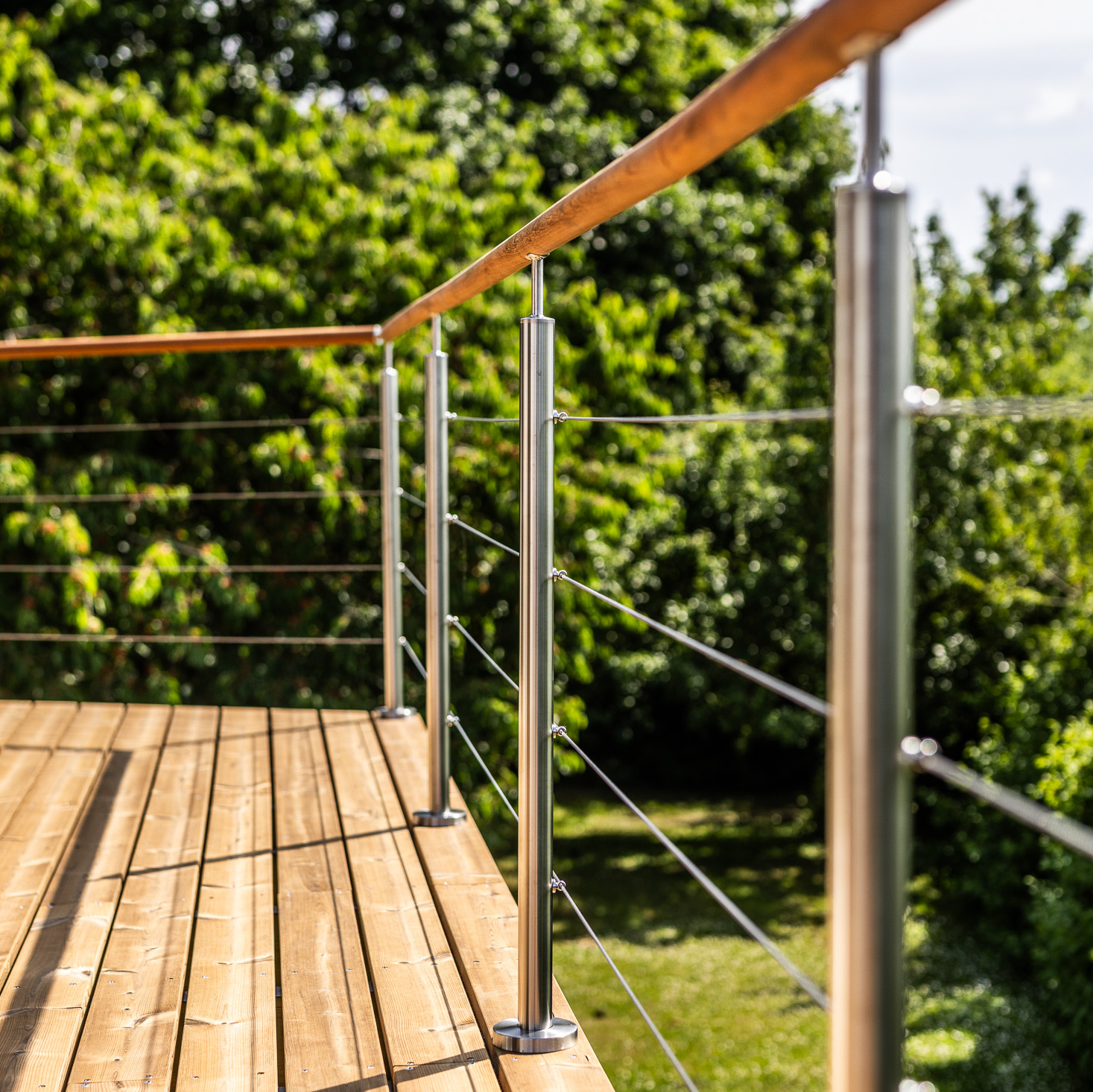
Timber and metal balustrade with stainless steel posts, wires and a timber top rail on a timber deck.
Timber and metal can serve different purposes in one balustrade: the metal forms the structure, while the timber top rail provides a warmer grip.

Why do timber and metal expand and contract differently in a balustrade?

Timber moves primarily when its moisture content changes, while metal mainly changes in length when the temperature fluctuates. The fixings therefore need to allow the timber to move without it being tightly locked against the metal frame.

Timber

Moves when the moisture content changes

When timber absorbs or releases moisture, it swells and shrinks. This movement is greater across the grain than along the grain and must therefore be taken into account when fastening the timber component.

Metal

Moves mainly when the temperature changes

Metal expands and contracts as the temperature changes. This movement occurs differently than the movement of timber caused by moisture, which means that the materials should not be joined together as if they were one and the same material.

When materials meet

Allow the timber to move at the fixings

If a timber component is securely fastened to metal at several fixed points, the timber’s natural movement can begin to put stress on the screw holes and fixings. Over time, this can lead to cracks or cause the fixings to deform.

How do you fix timber and metal together in a balustrade?

Install the components so that the timber can move, the contact surfaces can dry, and water can drain away. When timber is combined with metal in a balustrade, fixings, contact surfaces, screw holes, end grain, and drainage must therefore be addressed together.

Choose suitable fixings

Fixings must be suited to the type of timber, the metal, and the environment where the balustrade will be installed. Avoid material combinations where damp timber could affect the hardware or screws over time.

Avoid prolonged direct contact

A washer or spacer between the timber and metal can reduce direct contact while creating a small air gap that allows the surfaces to dry more effectively.

Give the timber room to move

The timber should not be clamped too tightly at each attachment point. An elongated screw hole can allow for movement as the timber swells and shrinks in response to changes in moisture content.

Protect the end grain before installation

End grain absorbs moisture more easily than other surfaces of the timber and can also be difficult to access once the component is installed. Therefore, the end grain should be treated before installation is completed.

Plan for drainage

Design the timber detail and the junction with the metal so that rainwater can run off. Avoid pockets and flat contact surfaces where water is likely to pool.

Which type of timber is best suited for an outdoor balustrade?

According to this comparison, jatoba is best suited for locations more exposed to the elements, while oak works well both indoors and outdoors, and ash is better suited for indoor use or more sheltered locations. Teak is naturally moisture-resistant but is used here only as a point of comparison.

Different types of timber also vary in appearance and maintenance requirements. An oiled surface retains its original colour longer than untreated timber, while untreated timber gradually takes on a more greyish, weathered appearance.

Timber species Character Best for Important to know
Oak Hard and classic Indoor and outdoor use Contains tannic acid, so choosing the right fixings is especially important. Outdoors, oak turns grey over time, taking on a silvery hue.
Ash Light-coloured and soft Indoor or sheltered use It has a lighter appearance than oak but is better suited for sheltered locations than those where the timber is heavily exposed to the elements.
Jatoba Dense and durable More exposed locations outdoors This dense timber withstands moisture better than many Nordic timber species and is therefore better suited for more exposed locations.
Teak * Naturally moisture-resistant Environments exposed to moisture It has traditionally been used outdoors because of its resistance to moisture. Untreated teak also changes colour over time.

How much maintenance does a timber and metal balustrade require?

Maintenance depends primarily on what proportion of the balustrade is made of timber. A metal frame with timber only at the top requires significantly less ongoing maintenance than a balustrade where the posts or infill is also made of timber.

If the timber is used primarily in a handrail or top rail, you’ll feel the timber where your hand touches the balustrade, while the surface area that needs to be cleaned and treated remains relatively small.

Less maintenance

Timber only in the top rail

When the timber is limited to the top rail, the total timber surface area is small. This means fewer surfaces to clean, inspect, and treat when the timber begins to show signs of wear and tear from the weather and use.

Suitable when you want a warm grip but prefer metal to form most of the balustrade.

More maintenance

Timber in posts or infill

When a larger portion of the balustrade is made of timber, the surface area exposed to sun, rain, and dirt also increases. This means more parts need to be checked and maintained so that the timber retains the look you want.

Suitable when the visual appeal of the timber is more important than minimising ongoing maintenance.

Maintenance depends on the amount of exposed timber

The less timber the balustrade has, the less surface area normally needs to be maintained. Therefore, a metal frame with timber only where it serves a functional or aesthetic purpose is often the easiest combination to maintain over time.

Which combinations of timber and metal work best for balustrades?

A timber top rail on a metal frame is a good starting point when you want to bring in the warmth of timber without increasing maintenance more than necessary. Other combinations are better suited when you want a more stainless steel, open, or timber-dominated look.

The key is to let the materials serve different purposes. Timber can provide texture, warmth, and colour contrast, while metal, glass, or wire can account for most of the balustrade’s visual and structural character.

Smaller timber surface

Timber top rail on an aluminium frame

The timber provides warmth and a more comfortable grip where the hand meets the balustrade, while aluminium makes up the majority of the structure. This creates a modern look with a distinct contrast in materials and a relatively small timber surface area that requires maintenance.

A clean-lined indoor look

Timber handrail on stainless steel

The stainless metal creates a cool, sleek look, while the timber handrail softens the overall appearance where the hand rests. This combination works particularly well on staircases and other interior balustrades.

Open appearance

Timber top rail on a glass balustrade

The glass preserves the sense of space and the view, while the timber provides a warmer finish at the top. This combination works especially well when you want to tie the balustrade together with a wood-clad façade, a timber floor, or other prominent timber elements in the space.

More timber

Timber posts with metal fixings

Here, the timber plays a much more prominent visual role, and the balustrade takes on a more timber-dominated appearance. At the same time, the amount of timber exposed to weather and moisture increases, which means more ongoing maintenance than when the timber is limited to the top rail.

A simple starting point

If you want to combine a warm, natural look with minimal maintenance, using timber only in the top rail is often the simplest solution. If you want the timber to be the dominant feature of the balustrade’s design, you’ll also need to expect that a larger portion of the structure will require ongoing maintenance.

What should you keep in mind when combining timber and metal in a balustrade?

Above all, check where the timber will be used, how exposed the location is, and whether the materials can be joined without moisture or the timber’s movement causing problems. This will make it easier to choose a solution that works both practically and over time.

Before installation

Review these six points

  • Is the timber being used where it actually makes a difference?

    If the primary purpose of the timber is to provide a warm grip, it may be sufficient to use it on the top rail or the handrail. This also reduces the amount of timber surface that needs to be maintained.

  • Is this type of timber suitable for this location?

    Estimate how much rain, sun, and moisture the timber will be exposed to. A type of timber that works well indoors or under a roof may not be the right choice for an unprotected outdoor area.

  • Are timber, metal, and fixings compatible?

    Fixings and fittings should be selected with consideration for the type of timber, the metal, and the environment. Also check whether the materials should be separated with a washer or spacer.

  • Can the timber move without being constrained?

    Timber swells and shrinks as its moisture content changes. The fixings must therefore be designed so that this natural movement is not concentrated at screw holes and fixed points.

  • Can contact surfaces and end grain dry out?

    Avoid designs where moisture becomes trapped between the materials. End grain and other exposed timber surfaces must also be accessible for proper treatment and future maintenance.

  • Is there a plan for future maintenance?

    Before installation, consider which timber surfaces need to be cleaned, treated, and inspected. The harder it is to access the timber, the more difficult maintenance will be later on.

In a nutshell

A good combination allows the timber to provide warmth and functionality where needed, while the construction takes into account moisture, material contact, and the timber’s natural movement. At the same time, a smaller timber surface area means less ongoing maintenance.

Handrail & top rail

Would you prefer timber where you hold the rail?

A timber handrail or top rail provides a warmer grip without the entire balustrade having to be made of timber. Our handrails and top rail are available in timber and metal and are custom-made to fit your project at our production facility in Ängelholm.

What do you need to know before combining timber and metal in a balustrade?

De vanligaste frågorna handlar om hur materialen ska mötas, hur träet får möjlighet att röra sig och hur mycket underhåll kombinationen kräver. Här är korta svar på några praktiska frågor.

Can you combine timber and metal in the same balustrade?

Yes. The combination works well when the fixing allows for the timber moving as its moisture content changes and the contact surfaces are able to dry.

Why can timber crack where it is fixed to metal?

If the timber is tightly secured at several fixed points, its natural swelling and shrinkage can put stress on the screw holes. This can cause cracks to form around the fixing.

Do timber and metal need to be separated from each other?

A washer or spacer between the materials can reduce direct contact and create a small air gap. This gives the contact surfaces a better opportunity to dry.

Why is it especially important to protect the end grain?

End grain absorbs moisture more easily than other surfaces of the timber and can be difficult to access after installation. Therefore, it should be treated before the timber component is fully installed.

Which type of timber is best suited for an exposed outdoor balustrade?

According to the article's comparison, jatoba is better suited for locations that are more exposed to the elements. Oak works well both indoors and outdoors, while ash is better suited for indoor use or more sheltered locations.

How can you reduce the maintenance required for a timber and metal balustrade?

Limit the use of timber to those areas where it provides the most functionality or aesthetics, such as the top rail. The less timber the balustrade has, the less surface area normally needs to be cleaned and treated.

Where in the balustrade does timber make the biggest difference?

Timber makes the biggest functional difference at the top rail or handrail where the hand meets the balustrade. There, you get the warmer feel of timber without the entire structure having to be made of timber.

Related products

More tips & ideas

logo

Get personal help – completely free

Select a country
Select a language

You are on the Balustradedesign United Kingdom website

Your basket will be emptied if you switch to another country.

Product Image

Environments
Products
