

An outdoor wrought iron railing provides durable protection with a classic, timeless look that can become a natural part of the home's architecture. How much maintenance the balustrade requires depends primarily on which material you choose.
Genuine wrought iron provides a traditional look but requires regular care to protect it from rust. Aluminium in wrought-iron style offers a similar look with lower weight and significantly less maintenance.
In this article, we’ll go over the differences between aluminium and genuine wrought iron, which colours and styles suit different homes, which regulations may affect the balustrade’s design, and how fixing is adapted to the surface.
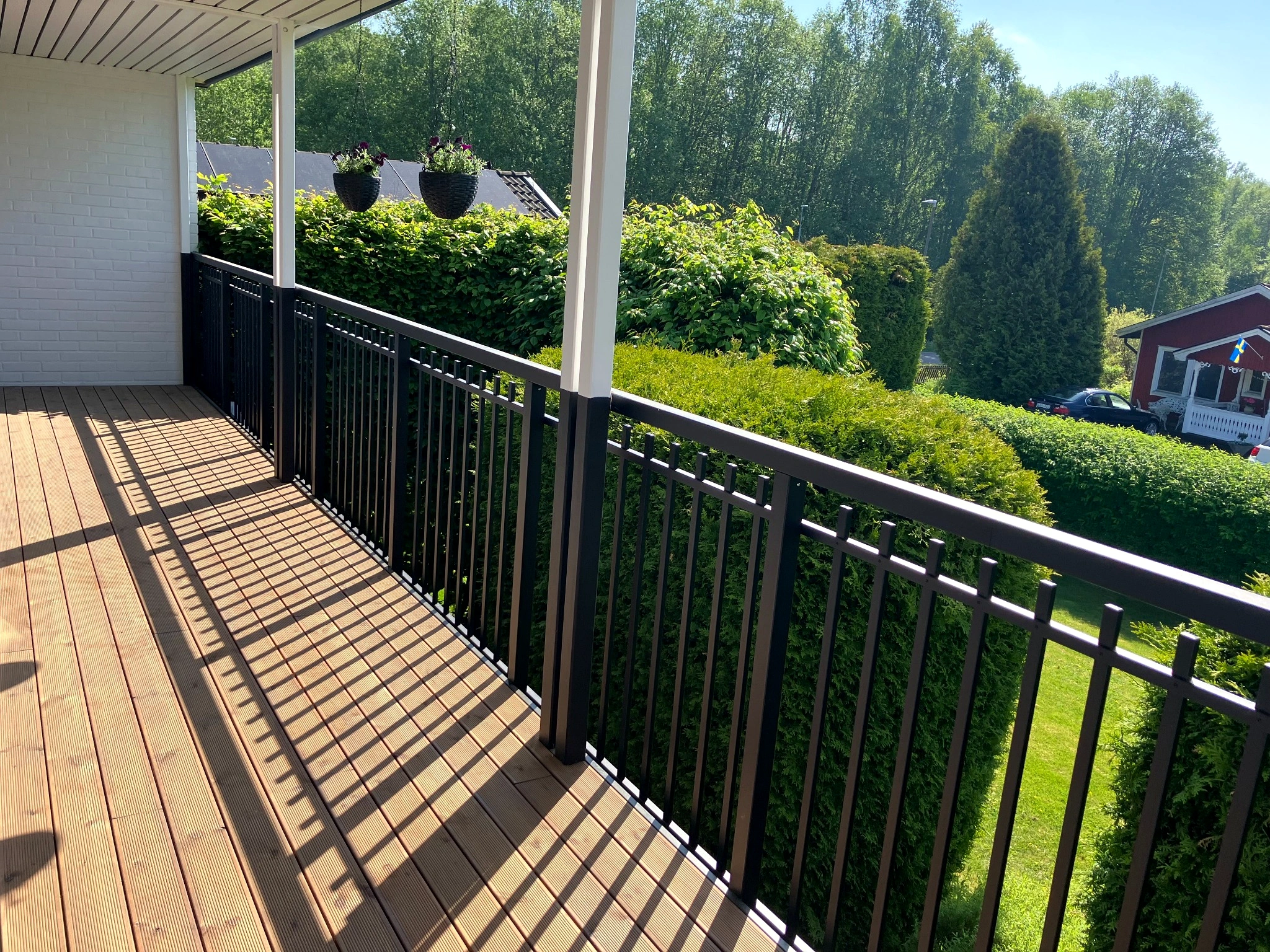
Where can wrought iron railings be used outdoors?
Wrought iron railings work particularly well on decks, entrance steps, balconies and retaining walls where they are intended to prevent falls while complementing the building’s architecture.
In older houses, this style can enhance the building’s character, while a simpler wrought iron railing design also works well in more modern settings. In coastal locations, the choice of materials becomes especially important because moisture and salt subject the balustrade to greater stress.
| Situation | Common problem | What the balustrade is intended to address |
|---|---|---|
| Balcony | The balustrade may look too visually heavy | Framing without dominating the outdoor space |
| Entrance steps | The need for support and a considered design | Support by the steps and a welcoming first impression |
| Balcony | The drop height affects the protective design required | Fall protection suited to the site conditions |
| Retaining wall | The difference in level creates a risk of falling | Discreet protection that follows the contour of the wall |
| Turn-of-the-century house | A modern balustrade can clash with the architecture | A style that complements the era of the house |
| Coastal location | Salt and moisture increase the strain on the material | A material and a surface treatment tailored to the environment |
Wrought iron railing in aluminium or genuine wrought iron?
The biggest practical difference is weight and maintenance. Genuine wrought iron has a traditional look but needs to be protected from rust through regular maintenance, while aluminium is lighter and does not require the same rust protection.
Our Retro wrought iron railings are made of powder-coated aluminium. This provides a classic wrought-iron look without the recurring sanding and repainting that wrought iron can require.
| Property | Aluminium in wrought-iron style | Genuine wrought iron |
|---|---|---|
| Classic appearance | Yes | Yes |
| Weight during installation | Low | High |
| Rust | Does not rust in the same way as iron | Requires a protective surface treatment |
| Maintenance | Clean as needed | May require sanding and repainting |
| Installation | Their light weight makes the parts easier to handle | The increased weight makes handling more challenging |
| Coastal location | Resistant to moisture and corrosion | More susceptible to rust if the surface treatment is damaged |
The visual appearance can therefore be classic in both cases. The difference is most noticeable over time: aluminium requires less ongoing maintenance, while iron needs effective rust protection.
What colours and design options are available for the wrought iron railing Retro?
Retro comes in three standard colours and can also be powder-coated in any RAL colour. You can also choose a top rail and add ornaments to make the look more classic or more pared back.
- Black textured powder coating, RAL 9005
- Classic and timeless. It offers the most distinct wrought-iron look and closely resembles the style of many older balustrades.
- White textured powder coating, RAL 9010
- Bright and light. Softens the look and is well-suited, for example, to functionalist homes and light-coloured façades.
- Grey with texture
- Modern and understated. The grey hue provides less contrast against many types of façade and stone materials.
- Any RAL colour
- Available as an option when you want to match the balustrade to, for example, windows, doors, or other features of the house.
How can you customise the look of the balustrade?
You can choose the top rail in aluminium, profiled oak, or jatoba. If you want to enhance the wrought-iron look, the balustrade can be complemented with ornaments in the shape of spheres or arrows.
The ornaments can also be added later if you want to start with a simpler look and change the style later.
Which wrought iron railing suits your home?
Take the house’s architecture and construction period as your starting point. Turn-of-the-century houses often look best with more decorative details, while functionalist-style buildings and many newer houses usually look more harmonious with straight lines and a simpler design.
More decoration and vertical rhythm
Scrollwork, leaves, closely spaced slats, and other classic details can blend well with the house's original architecture.
Straight lines and clean proportions
Simple profiles and few or no ornaments are often a better fit. The character lies primarily in the proportions and the minimalist look.
Lighter and more geometric
Slim profiles and simple, repeating geometric motifs create a light and airy look that suits many homes from that period.
Minimalist, with no clear indication of the era
A simple balustrade without strong period-specific features often works well and is easier to adapt to future changes to the house.
What height should a wrought iron railing be, and what rules apply?
The height required for a wrought iron railing depends on drop height, how the location is used, and the requirements that apply where the balustrade is to be installed. The design must therefore be assessed based on the specific location rather than a single, general height measurement.
The design of the balustrade needs to reduce several different risks
In areas where young children may be present, the balustrade must be designed, among other things, to prevent climbing, falling through openings, and the risk of becoming trapped. The exact dimensions and requirements must be verified for the specific location.
The balustrade should be designed without easily accessible footholds or other parts that make it easy for young children to climb up.
The spacing between the spindles and other parts must be designed so that a young child cannot squeeze through the balustrade.
The gap between the bottom edge of the balustrade and the floor, stair tread, or other surface must be assessed to ensure that it does not pose a risk of falling or getting pinched.
On stairways, landings, and other changes in level, both the height of the balustrade and the openings around the balustrade must be adapted to the design and the risk of falling.
Assess the size, direction, and placement of the openings so that younger children do not risk getting their head, body, or foot stuck.
Drop height and intended use determine the protection needed
The need for a balustrade or other fall protection must be assessed based on the risk of falling, how the area is used, and the structural conditions. Therefore, check with your local authority or the relevant body to find out what requirements apply at the specific location.
How do you install a wrought iron railing on different supporting structures?
Fixing is selected based on the surface and where the balustrade will be installed. Top-mounted fixing is suitable for solid surfaces such as deck boards and concrete; the side mounting can free up floor space; and plinth mounting is used when the balustrade needs to be anchored to the ground.
Retro is delivered as a made-to-measure kit with pre-drilled parts, screws and fixings. The light weight of the aluminium makes the parts easier to handle during installation.
Choose fixing based on the substrate
- Top-mounted with a base plate
- Suitable for use on, for example, a deck, concrete slab, or stone surface where the post can be anchored on top of the load-bearing surface.
- Side mounting
- Ideal for use along a staircase or on the side of a balcony, for example. The post is mounted on the side of the structure and therefore takes up less space on the walkway or floor.
- Fixing to a concrete pier or foundation
- Used when the balustrade needs to be anchored to the ground, for example, on soil, gravel, or next to a wall.
What should you check before ordering a wrought iron railing?
Check the architecture of the house, the fall risk at the site, the style and colour of the balustrade and the substrate it will be fixed to. This makes it easier to choose a balustrade that works both visually and practically.
Check these six points
-
Take the house's architecture as your starting point
Find out when the house was built and what its architectural style is. This provides a good starting point for determining how ornate or minimalist the balustrade should be.
-
Assess the drop height and intended use
Check the site's drop height and how the area is used to determine the required height and design of the balustrade.
-
Choose a style
Choose a style that complements the era of the house, or a more minimalist option if you want the balustrade to be less period-specific.
-
Choose a colour
It helps to start with a colour that’s already on the house, such as on windows, doors, or other metal details.
-
Choose a top rail
Decide whether the balustrade should have a top rail in aluminium, profiled oak or jatoba, and how the choice affects its overall look.
-
Check the substrate
Determine the type of substrate to which the balustrade will be anchored, and choose fixings based on the design and on-site conditions.
Start by considering the site's safety requirements and the surface conditions. Then adapt the style, colour, and details to the house so that the balustrade serves as both a safety feature and an architectural element of the environment.
Which wrought iron railing suits your home?
Start by considering the house’s year of construction, its style, and the colours already present. Customer service will be happy to assist you with measurements, style, and fixing before you place your order.
What do you need to know about outdoor wrought iron railings?
Here are brief answers to frequently asked questions about materials, installation, maintenance, and options.
Rostar ett smidesräcke i aluminium utomhus?
No. Aluminium does not rust in the same way as iron. It forms a protective oxide layer, and Retro is also powder-coated.
Can I fit a wrought iron railing to a timber deck?
Yes. Top-mounted fixing with a base is used, for example, on decks, concrete slabs, or stone surfaces where the post can be anchored on top of the load-bearing surface.
What material is best suited for a wrought iron railing near the sea?
Aluminium is a practical choice in coastal locations because the material does not rust and is resistant to moisture and corrosion. Iron requires more protection if the surface treatment is damaged.
Can the ornaments on Retro be fitted later?
Yes. Ornaments in the shape of spheres or arrows can be added later if you want to start with a simpler look and change the style later.
How do I clean an aluminium powder-coated wrought iron railing?
Wipe down the balustrade with lukewarm water, a mild detergent, and a soft cloth as needed. Avoid abrasive cleaners, acids, and alkaline cleaning agents that can damage the powder-coated finish.
Can I choose a colour other than black for Retro?
Yes. The Retro is available in black textured paint, white textured paint, and grey textured paint as standard. In addition, the balustrade can be powder-coated in any RAL colour.

